Posts for: #NSA

Part 3: PRISM and Upstream

Initially I wrote about PRISM and how a lot of people felt it was a tool to intercept communication in flight to companies like Google and Facebook, however slightly more details have emerged to debunk that claim.

However, it’s of paramount importance that we understand what people are saying. No one is denying that communications aren’t being intercepted on their way to Google, Facebook or Apple, instead what they are denying is that the capability to perform that interception and storage is under purview of another program called Upstream, and that analyst like Edward Snowden at the NSA were encouraged to use both PRISM and UPSTREAM.
PRISM and Upstream

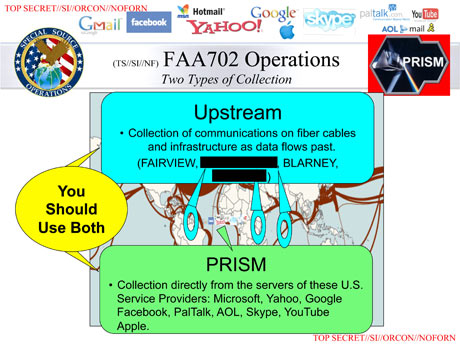
What the crudely drawn powerpoint on the left is trying to describe is the distinct-ness of the programs and how each program would complement (rather than replace) the other.

The release of this particular slide was done shortly after the initial news broke to, in the interests of aiding the debate over how Prism works. 

The Guardian have intentionally redacted some of the program names from the slide, presumably in an effort to milk this story dry for all that it’s worth, but probably also to keep the momentum of the debate just in case people move on. However, in their own words the slide:

details different methods of data collection under the FISA Amendment Act of 2008 (which was renewed in December 2012). It clearly distinguishes Prism, which involves data collection from servers, as distinct from four different programs involving data collection from “fiber cables and infrastructure as data flows past”.

The of course points to separate approaches, one where information is accessed directly from the servers their stored in (data at rest), and one where information is collected while in transit (data in transit).

This distinction resonated with me, simply because I read about this a couple of months back when another wanted man name Kim Schmitz was making the news instead of one Edward Snowden.
[Read more]

PRISM and Tempora

GCHQ Mastering the Internet

As Edward Snowden begins to look for more ‘accommodating’ countries who wouldn’t mind playing host to a man that currently is more wanted than Osama bin Laden, Saddam Hussein and Kim Kardashian combined, more details slowly begin to emerge about PRISM, painting an ever clearer picture of the extent of the program both Stateside and abroad. Each individual piece of information that filters continues to sharpen the image we have on just what the NSA has (and probably still IS) been surveilling.

However, we also need to acknowledge a separate project called Tempora, which is the British equivalent of PRISM–or since we don’t know the full details of PRISM–we can at least infer that both Tempora and PRISM share the same objectives, which was to spy on internet communications of netizens throughout the world. As of last year, the British had finished attaching probes to 200 fibre-optic cables each with a capacity of 10 gigabits per second. Which would have granted them access to 21.6 petabytes  of data on a daily basis. This we are told is just the half-way point!

Basically the British government through the Government Communications Headquarters (GCHQ) was accessing a vast majority of data flowing into and out of its borders, most of which probably didn’t originate in the UK and was merely transiting through it. The GCHQ is itself a pseudo-military agency which traces its roots back to World War 1, when communications jamming involved shooting carrier pigeons. Which means that a military organization is looking at private citizen data of not just UK citizens, but possibly Europeans, Japanese and even Malaysians, as the internet traffic we use on a daily basis route through Europe and UK before finally landing on the US East Coast.

The interesting though, is that Project Tempora is based in the UK, while PRISM is based in the US, and while local regulations prevent local agencies like GCHQ and the NSA to spy on their own citizens within their own borders, it is physically impossible for a person to be both in the UK and the US at the same time–damn laws of physics….. Which essentially means that between Tempora and PRISM, both the UK and US government can spy on the whole world, and that’s probably what they’re doing.

The UK is a favourite landing spot for all those undersea cables that transverse the atlantic, carrying internet traffic between Europe and the US, and if you’re wire-tapping the lines between the UK and the US, it’s almost a certainty that you’re tapping nearly all of Europe. Which would explain why the Germans aren’t too happy about the recent revelations of Project Tempora, and have sent a list of questions to the British Embassy in Berlin. If I were the German chancellor I’d be very interested in the details of the project, primarily around why it’s named after a Japanese delicacy–oh wait that’s Tem-PU-ra.

[Read more]