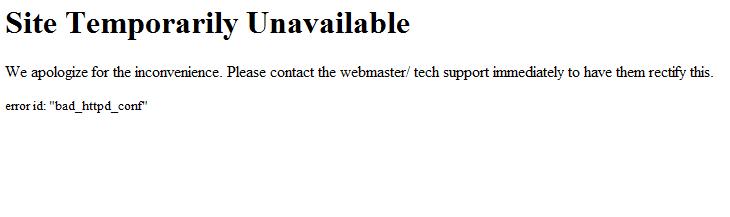
Damn you!! error id: “bad_httpd_conf”

If you’ve wondered what happened to my 30-day challenge to blog everyday….well it didn’t go so well. So far, I’ve fallen short last Friday (although I posted twice the next Saturday) and then missed posting this Friday and Saturday as well, turns out my challenge is pretty much over. Although, I’m still persevering, I guess even if I complete the remaining 20-odd days, I’ll always ‘know’ I missed 3 days!!

Now I’m not one to make excuses but the reason I missed these last 2 days was because I was trying to get my blog migrated from nearlyfreespeech (who are awesome by the way) to dreamhost. It took me a while to figure out all the nooks and cranies and nearly 4 hours to complete the migration. I’ll blog about migrating your wordpress once it’s done.

[Read more]

What is SOPA?

A couple of days ago, I stumbled onto a website by mozilla claiming “The internet we know and love is at risk”. Now I’m not one to panic but this was some serious stuff here, Mozilla is a company I admire and respect, so if it tells me something serious is going down, I stand up and pay attention.

Further reading brought on a couple of key points, namely that Mozilla was talking about the new Stop Online Piracy Act (SOPA) that was designed to stop online piracy, but what it would effectively do was make give copyright holders essentially too much control over their copyrighted material. Now copyright holders undoubtedly have legal rights to their work, but giving them the right to shut down YouTube because someone sang their song and posted a video takes that a bit too far.

Mozilla also claim:

The fact is that this legislation as written won't stop piracy. But it would pose a serious threat to social media and user generated content sites (like YouTube) across the internet. It could also undermine some of the core technical systems underlying the internet, creating new cybersecurity risks.

As a non-profit committed to keeping the web open and accessible to all, Mozilla wants to ensure that this legislation does not jeopardize the foundational structure of the Internet.

Unfortunately, I’m not a US-Citizen so I can’t join in the calling to US members of Congress, but you probably can. Over here in Malaysia we’ve got our own laws we need fighting. Visit here if you wish to join Mozilla and their cause against SOPA.

[Read more]

Cloud investment: Is Cisco the next big thing?

Well technically Cisco is a big thing already, a company that by itself is defining the internet as we speak with mind-blowing efficiency. Sure, Huawei thinks they’re catching up, but the truth is Cisco is in a league of it’s own, literally.

Today, I bumped through 2 articles I thought were pretty interesting. Cloudbeat, a blog I just recently subscribed to, reported that Cisco thinks “that global traffic generated by cloud computing services will increase a staggering 12 times by 2015 compared to cloud traffic in 2010, while data center traffic will increase at a less-showy-but-still-impressive four times by 2015”. Now that’s a whole bunch load of traffic the internet is going to have to contend with, more interestingly though I was surprised that it was Cisco who did the study, not Amazon or Microsoft or Rackspace, not any traditional cloud computing company? Why would Cisco be so interested in checking out cloud traffic?

[Read more]

Googles Wi-Fi strategy: The Power of Defaults

One of my favorite blogs, nakedsecurity recently published an article that Google "offering to stop mapping wireless access point location data, granting network owner s worldwide the choice to opt out from its Wi-Fi geolocation mapping". The problem is, that Google is asking users who want to opt-out of their service to change the SSIDs of their Wi-Fi and add a _nomap postfix. This means that all Wi-Fi networks without the _nomap postfix would automatically be added to Googles database of Wi-Fi access points.

What does this all mean? Well apart from the obvious icky feeling you have in your stomach right now, the main summary is that Wi-Fi access points that aren’t changed will automatically be added to Googles database (the Google Location Server). In short, the default setting is that you give permission to Google to store your Wi-Fis SSID until otherwise stated….eeeyeew.

[Read more]

IaaS vs. PaaS vs. SaaS: What do they mean?

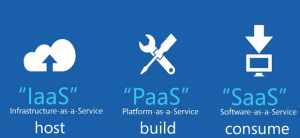
With the advent of cloud computing came the dawn of new terms for acronym savvy geeks to drool over, one of the most famous groups of these acronyms are the ‘aaS’ acronyms. These are the acronym that start with a letter or two and then end with an ‘aaS’.

Cloud computing isn’t fully defined right now, formal definitions usually naturally evolve once adoption rates reach a certain threshold. At the moment that threshold isn’t yet reached, so we don’t yet have a fully agreed upon definition. However, it’s a common understanding that the cloud comes in various flavors, 3 ‘major’ flavors to be exact. Iaas, Paas and Saas.

The ‘aaS’ stands for ‘as a Service’ , and it means that whatever it was that preceded it now can be treated as a service, and before we begin to move into that, it’s important to define what exactly a service is and why is everybody offering stuff as a service.

In the realm of selling stuff, the general categorization of ’things you can sell’ is basically products or services. No matter what you sell, regardless of where and when you’re selling it, everything you sell is either a product (an actual tangible ’thing’) or a service (less tangible but requiring effort). So basically every business revolves around the sale of either a product or a service or both.

[Read more]

We’re not separated by 6 degrees of separation: It’s now only 4.74

According to a New York Times article today, the world has apparently shrunk beyond our imagination. The latest study uses facebook as the base for their study, and used it to study the separation of people.  Previously I blogged about the amazing study conducting by (even more amazing) Stanley Milgram and how he came up with the concept of 6 degrees of separation. The latest study not only re-inforces the original study, but goes further to explain that the number is now only 4.74.

It really is a great opportunity we have now with facebook being the Hyper-Social network, with little competition. What this means is, at least for now, everybody online has a facebook account. That would certainly change in the nest 2-5 years, but what’s really interesting is that with facebooks great popularity, we have now have a wonderful chance to perform these kinds of research, and kudos to facebook for actually initiating it. The data from the research can be found on facebooks data page. Now onto the research:

[Read more]

Security on the Cloud: Does PCI compliance matter

The main concern companies have in migrating to the cloud is security. That in one sentence covers cloud computing greatest hurdle, as more and more companies are beginning to see the benefits (economically) of moving their infrastructure and data to the cloud, the major turn-off is control. In essence, the greatest advantage of cloud computing is also it’s biggest detractor. Companies (especially non-IT companies) are really interested in letting someone else run their IT infrastructure, but their uncomfortable letting someone else run the IT infrastructure due to the security concerns.

In my work, I often deal with PCI-DSS (Payment Card Industry Data Security Standard), which is a benchmark of sorts on how secure your servers are. In the banking world, any application,system or vendor hoping to store, transmit or process credit card information needs to be PCI-DSS compliant. If you thought pronouncing the acronym was difficult, adhering to and complying to the standard is even more so. In fact, the direction now is to use certain ’tricks’ to avoid having to be PCI-DSS compliant, including implementing point-2-point encryption (thereby disregarding the need for PCI-DSS compliance on all intermediary systems) or using tokenazation (to replace the card number with a token that can redeemed from a secure vault). The main direction is clear, compliance to security standards is mandatory and non-negotiable, but it’s also expensive and time-consuming, and anything that can help reduce the effort and cost is really taking off (just ask shift4).

[Read more]

The internet is killing newspapers and how we can change that

On day 4 of my 30-day challenge to blog everyday, and I’m already running out of stuff to say. However, as with most things, inspiration seems to spring out when it is most required. I’m sitting in front of TV, watching BBC Dateline and one of the panel members is Henry Chu, the Los Angeles Times bureau chief in London.

The topic of the discussion was something along the lines of “Are newspapers going out of date, and what is the future of newspapers?”. Henry answered in a rather poignant way, circulation of newspapers throughout the world including the Los Angeles Times is decreasing, but the irony is that while circulation is decreasing, readership has increased. So think about it, less people are buying the newspapers but more people are reading it, and the newspapers have actually become a lot more interactive. For instance content of the LA Times is now not only being read by people outside of Los Angeles (or even the US) but actually being commented on by people from Australia and Malaysia.

The reality is that while newspaper circulations have been reducing over the years, the appetite for news has not decreased, and neither has the demand for it. What has happened is the nature of the demand has changed, and consumers now demand that their news sources fulfil these new demands or they’ll take their business elsewhere.

[Read more]

3 Reasons to say NO to Yes Mobile

I recently purchased a yes mobile account, and was pretty happy the results. In my past review I mentioned that the speed was great followed by good stability. However, there have been some downsides to the service, and here’s some reasons why you should avoid yes mobile.

While Yes is great, there are overall flaws with the service, and below is my review of 3 reasons why you shouldn't use YTL Yes 4G.

Before I move to the reasons, let me explain the kind of user I am. I work from home 3 times a week and use my laptop for just about all my working needs which include late night teleconferences, phone calls (via my companies VOIP) and even for webcast and presentations that I do on a regularly basis. Working from home has it's advantages, for one I don't travel too often and can usually get a lot of work done. However, if my internet connection is down, I'm completely cut-off from the office, with no office communicator and email, there's very little I can do at home. Even worse, if the internet connection goes down before a teleconference (or even during a teleconference), things get pretty ugly pretty fast. I absolutely need a stable and reliable internet connection and chose Yes 4G because I thought it would provide me that, turns out I was wrong.

[Read more]

Facebook sues developer while Google takes youtube domains: What’s the difference

wpCandy reports that Facebook recently sued an Indonesian blogger who created a wordpress theme that could turn your wordpress site to look like Facebook, and the similarities were really striking. For one your post look exactly like status updates on your Facebook profile and comments on those post look exactly like your friends commenting on your status updates in Facebook.

Similarly, TechCrunch reports that Google has gone after a couple of rather confusing typo domains that look remarkably similar to Youtube. Although not so similarly, Google is making a request for control of the domain rather than suing the pants of those cybersquatters (which it probably should), and not so similarly Google has a much stronger case.

[Read more]