4 ways to add Pinterest ‘Pin It’ button to Wordpress

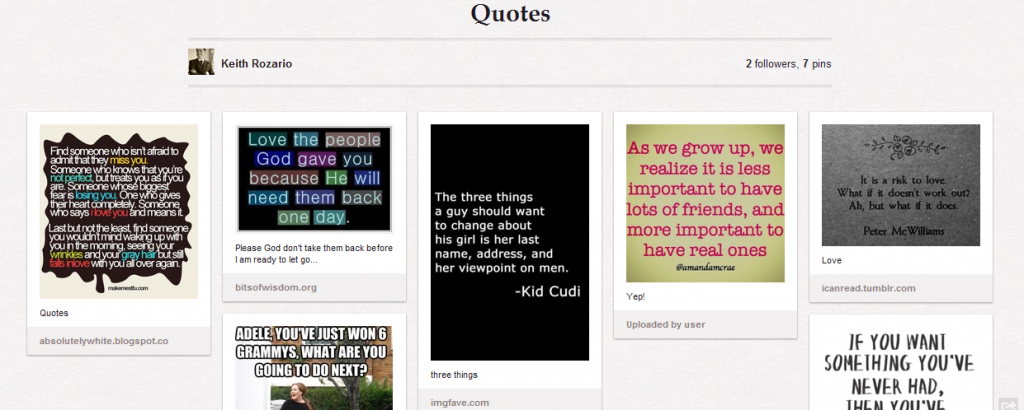
Pinterest is an awesome social site that let’s you ‘pin’ up interesting articles on boards that other users can view and then continue sharing. It’s absolutely amazing, and I’m in love with it. If you’re still curious about what Pinterest is or want to snag an invite (it’s still invite only btw), then just leave a comment at the bottom of this page and I’ll send you an invite as soon as I can. If you don’t know what Pinterest is, just head over a board I created from random quotes I saw from other users over here http://pinterest.com/keithrozario/quotes/.

[Read more]

Unifi vs. Yes : The speed showdown

Alright, so my Unifi is back up and running, apparently it was an area wide network issue that caused half my town to experience a Unifi Blackout, I have thus named this debacle, the Great CNY blackout of 2012. I was left 9 days without an internet connection and was forced to reload my Yes Broadband package to go online.

Anyway, with a little credit left on my Yes broadband account, I decided to test out the speeds of Yes against my Unifi connection and see who comes up tops.

Some disclaimers before I continue, I ran this test on a Saturday morning where web-traffic shouldn’t be too high in Malaysia, and I subscribe to the 5Mbps Unifi Package and a standard Yes pre-paid package. I also decided to run 4 test per ISP, and then compare the results. First I tested against 2 local servers (Singapore considered local here), and then 1 test each to the US and Europe. I used speedtest.net and while the results will probably be inconclusive, it’s a good benchmark to use in case you’re wondering whose faster.

[Read more]

Using the crowd to predict the future

I just finished Crowdsourcing by Jeff Howe, the definitive book on crowdsourcing, and although it was written nearly 4 years ago, I was really bowled over by key insights throughout the book. Crowdsourcing is more than just the design work or iStockphoto, there’s also an offshoot into the world of Crowd-predicting. Utilizing the wisdom of the crowds to predict anything from sports results, Hollywood sales or even Presidential elections, and it appears these prediction markets actually do a pretty good job of predicting the correct outcome. They’re not right 100% of the time (then again neither are the experts), but overall the Crowds can –and do–predict with great accuracy.

The premise of crowd-predicting is simple. Get a whole bunch of people together and then ask them to predict the outcome of a particular event, once each individual prediction comes through you then aggregate that information to get the final result. Proponents of crowd-predicting say this result often beats the ’experts’, and they have some data to back it up.

[Read more]

My Last Hope on Unifi: Twitter

[blackbirdpie url=“https://twitter.com/#!/keithrozario/status/167140677531074560”]

I posted the tweet above about 40 minutes ago, complaining about my omni-present (or omni-absent) Unifi connection issues about an hour ago.

Barely 30 minutes later, a friend of mine retweeted it and cc’ed a TM twitter account @TMConnects

[Read more]

When only the best would do: Organics

I used to be a strong believer of organics, until I saw the prices of organic foods at my local Jusco. Needless to say, I stopped believing in organics pretty quickly. Of course, I understand the premise, which is that organic food is 100% natural, without added chemicals or fertilizers, no herbicides or pesticides leaving your food 100% wholesome. There is strong justification for this, although limited scientific proof.

The way to think about organic is that, mankind evolved to consume certain types of food and nutrition, but with the advent of ‘industrialized agriculture’  things changed. We now consume tomatoes all year round, although it’s a seasonal fruit, the concept is simple–pluck the tomatoes when they’re ripe and then spray them with chemicals just before they hit supermarket shelves, that way nobody needs to worry about seasons. This is true for nearly all your seasonal fruits that appear ‘all year round’. All this makes the fruit un-natural or at least–less nutritious than it’s purely organic counterpart.

[Read more]

Did an email to the CEO really help restore my Unifi services?

Just this morning I wrote about how my Unifi services went down and how I wrote a letter to what ‘appears’ to be Telekom Malaysias CEO email address.

A lot of Malaysians are skeptical that CEOs would actually respond to emails. Steve Jobs has responded to many emails personally and so has his successor Tim Cook. There have even been reports of Palm's CEO responding to customer query and even non-tech companies like home depot doing the same.

These however are American companies, not Malaysian, would a Malaysian CEO actually respond to an email from a small-time RM150/month customer like myself? I figured why not give it a try, I was already internet-less -- what more is there left to lose?

[Read more]

Unifi sucks: Here’s why

Last year I moved into my new place, and had to apply for Yes! broadband because my place wasn’t Unifi ready yet. I blogged about how much I enjoyed the Yes! experience and even recommended it to most friends and family. That little love affair however took a turn for the worst when I discovered Yes! would experience a service interruption nearly once a month and the overall design of the Yes! service was lacking. So in the end I parted ways with Yes! and subscribed to Unifi instead.

[Read more]

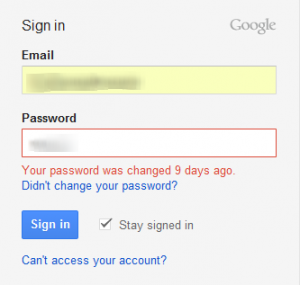
Good Design: Google reminds you that you recently changed your password

A couple of weeks back, Dreamhost reported a security breach on it’s servers, so I thought for security sake I should change my passwords as well. I’d been using the same password for the past couple of years and it was time for a change anyway.

However, as most of you will notice,  whenever you’ve just changed your password you instinctively try to re-enter the old one on your next login. This obviously prompts and invalid password prompt which should point you in the right direction. If you’re like me though, you end up thinking you typed it wrongly and try again, this can go on for a while and if you’re not careful you could lock yourself out of your account because you entered the ‘old’ password 3 times in a row.

A good piece of design I noticed from Google is that if you’ve changed your password recently, they actually remind you that you changed it and when you changed it. Thereby stoping your automatic response in it’s track and getting you to type the new one. Just a small piece of code and small feature but a rather good piece of design.

[Read more]

Can we use crowdsourcing for Autistic people?

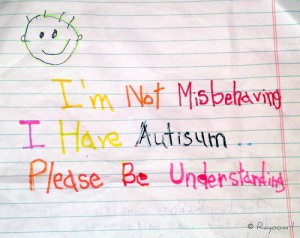
Yesterday, a doctor by the name of Sandra posted a comment on my blog about how she thought crowdsourcing could help disabled people particularly those with bipolar disorders get jobs online. If anyone in the crowd can contribute to a crowdsourcing initiative then even those with bipolar disorders should be able to do it, and they should be paid the same amount. It got me thinking about an article I read in the New York Times some months back on a non-profit startup called AspireTech was actually getting work for autistic adults not ‘despite’ them being autistic but because they were autistic. Autistic people are generally able to perform the same repetitive task over and over again without losing focus or getting lethargic, and they’re way more adapt at this than the rest of the general population.

This fundamental advantage they have makes them perfect for roles as software testers and even programmers. I always dread testing anything, especially when it’s doing the same thing over and over again, let try uploading a 5MB file, now a 10MB file, now a 100MB file…on and on and on. These test provide critical data for any software project but can be very very cumbersome to accomplish since they require repetitive work to be done over and over again with minimal variance. At least it’s hard for me to do, particularly since my wife says I’m not too good with instructions.Individual with autism are extremely adapt at this and they’ve proven their worth. In these areas autism is an asset not a liability.

[Read more]