IT Career in Malaysia : Why Information Technology rocks

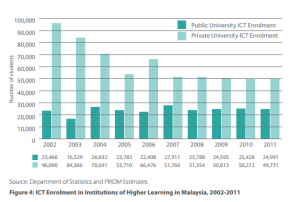
Number of IT Graduates in Malaysia by Year

So your child has just finish SPM or STPM or A-Levels and now you’re looking at a possible future career for them, or you yourself have just graduated and considering your future career. This is not something to take lightly, after all it’s the 4th most important decision in your life, behind who you get married to, when to have your first child and which EPL team to support. (hint: the answer to last one should start with M and end with anchester united)

Of course, there’s a lot of things to consider when choosing your future career and usually it’s a mixture of passion, interest and future career opportunities.You want a career you like and have interest in, but you also want a career that has future growth possibilities that match your aspirations (do you plan to live in Malaysia or move abroad…etc etc), and if you plan to stay in Malaysia you need to pursue a career that’s growing in Malaysia not something that’s growing somewhere else.

So while it’s great that you like palaeontology and want to contribute to your Tanah Air, but you’re going to be very hard pressed trying to find opportunities for digging up Dinosaur bones in Malaysia. At some point you need to keep certain things as hobbies and find a career that’s offers more progression opportunities. Or make the difficult decision of pursuing your passion somewhere other than Malaysia. It’s a difficult decision obviously, and sometimes you don’t have enough information to make these decisions–but thinking of these things now will save you a lot of heartache later on.

I think we need a lot more engineers and IT professionals in Malaysia, all this talk about transformation from the government isn’t going to happen with lawyers or politicians–it’s going to happen with technology, and unless we have more technically focused professionals entering the workforce, no transformation is going to happen (or at least no ‘good’ transformation).

Unfortunately, not many people seem to agree with me and usually when people don’t agree with me–people are wrong (the only exception to the rule is my wife).

However, I can’t understand had a decline in IT graduates over the last 10 years, and at the same time have an increase in IT opportunities in Malaysia?

A Jobstreet/Pikom report on the ICT industry in Malaysia reports that we’ve gone from 120,000 graduates per year, to just 75,000 graduates per year. That’s a bad sign on so many levels, so today as my little bit of service to the IT community in Malaysia, I’d like to tell you why a career in IT rocks.


[Read more]

Evidence Act: Anonymity before the internet

I read a brilliant article on the Evidence act by Zul Rafique and Partners that I think everyone should read. In it, the author compares the newly amended Evidence Act (supposedly amended to combat the evils of the internet) to a sub-section of the original act meant to look into telegraphs. Now I must admit, that as an internet kid, I don’t quite understand the concept of a telegraph, but the point is that even before the internet Anonymity was possible.

The public perception that is reinforced by ignorant government statements, is that with the internet has enabled anonymity which in turn has enabled crime.

According to Datuk Seri Mohamed Nazri Aziz, Minister in the Prime Minister Department, the amendments were tabled to address the issue of Internet anonymity since this very fact makes it extremely difficult, if not impossible, to trace the alleged offender.

That is a false statement.

Let me introduce you to snail-mail.

In the past, long before the internet was around, people use to communicate via letters and postcards that were hand-delivered by postmen to your doorstep. This is a foreign concept to most children but it’s good to let them know just how hyper-connected they are in relation to their parents or grandparents.

When you send a letter, you write a note on a piece of paper, sign it at the bottom (presumably with your name) and then place it into an envelope. You then write the name and address of the recipient on the envelope, afix a stamp (that acts as a proof of purchase)–and then drop it off at any post office you see fit. The Post Office then somehow routes that letter to the recipient on the envelope–physically hand delivered.

Notice–you never have to prove your identity when you send a letter or postcard. No where in the chain of events are you ever asked for your IC or phone number, in fact I could just as easily write a malicious letter, post it to the Prime Minister and sign it as Datuk Seri Mohamed Nazri Aziz. Would the Prime Minister then automatically assume his cousin sent him the letter just because it was signed in his name?

I guarantee you it’ll be harder for the authorities to trace that physical letter as opposed to a similar digital email. Too many people watch CSI these days to believe that statement, but there’s a reason why kidnappers still use physical constructs–because in the digital world you always leave a trace.

If we apply the amended Evidence Act to the letter analogy, Datuk Seri Mohamed Nazri would be charge for sending that malicious letter to the Prime Minister–even though he never wrote it. All of us understand the stupidity of assuming someone sent you a letter just because the letter was signed by that person, yet we seem to think nothing of it in terms of emails. In fact, if I wanted to get Nazri into a whole heap of trouble, all I’d have to do is send 1000 similar letters to 1000 different people, and sign it with his name–in that way, he’d be charged 1000 different times in a 1000 different court proceedings and even though he might be deemed innocent on each count, it’s still a whole load of trouble I can cause for him for the price of 1000 stamps (roughly Rm500 which wouldn’t pay for even one hour of a lawyers time).

[Read more]

Online Medical books in Malaysia: Unibooks.com.my

Unibooks Malaysia

A rather entrepreneurial friend of mine realized the Malaysia didn’t really have any niche bookstores that offered free delivery. Sure all the medical students knew where to get their textbooks from, and the designers knew where the best design books could be bought–but for the most part that involved a long trip to somewhere to the older parts of KL just to purchase a book or two. For some that may be a worthwhile sacrifice, just like buying electronics from lowyat, but for others that may involve either driving from Penang or even further just to get your hands on a desperately needed textbook at a an affordable price, that seemed a rather big price to pay.

So looking into that gap, he decided to start Unibooks, and what really makes me excited for him is the speed in which he manage to create the startup from nearly scratch and the fact that we’re seeing a lot of local startups flourish to meet the needs of Malaysians–the same needs that seem to be ignored by the bigger retailers.

Auditor-General report 2011 : When can Malaysians expect Transparency in IT spend

How much does Putrajaya Spend on IT?

As a tech blog in Malaysia, I thought it’d be interesting to see the latest Auditor-General’s report faired in terms of IT spend from the government. IT spend is a tricky thing, and most don’t understand just how tricky it is, particularly around big IT spend by governments–they often fail. In fact, one of my favorite blogs is dedicated solely to IT failures, aptly titled–IT Project failures.

However, even the Synopsis report of the AG report is a harrowing 87 pages long. It’s not just the length that puts of me off, but rather the sheer dry-ness of the language that is used. Interestingly, not a single diagram exist in the documentation filled with enough monotone text to put even the most ardent auditor to sleep, and I’m no auditor so I nearly dozed off after the 2nd page. I had to take a different approach if I was to get a synopsis of the synopsis, fortunately I work in IT (not auditing or law), and I know of function in Adobe Acrobat that let’s you quickly search a document–it’s called the FIND function, and I was a deadly ninja in the art of the FIND.

So, armed with the FIND function on Adobe Reader, I combed through the document looking for the word ‘system’ and where it tied with an actual IT system too see just how well our government was in delivering IT systems in 2011. Below are just a few paragraphs pertaining to the AG’s report and below are 2 prime examples of the the magnitude of IT failures from Putrajaya.

Sumptuous Erotica and Barisan Nasional

Alvin and Vivian interview on youtube

In case you've been under a rock for the past week let me fill you on some details:

Alvin Tan and Vivian Lee–both Malaysians started a little porn blog called Sumptuous Erotica attracted headlines both in Malaysia and across the causeway. However, unlike other couples who’ve been caught with their pants down before, both Alvin and Vivian seem indifferent to the controversy surrounding them, more importantly they seem quite confident that they’ve done nothing wrong and have nothing to apologize for to anyone.

On the face of it–they’re right. Whatever you think Alvin or Vivians parents have against their children posting pictures of themselves naked online…that’s a matter for them to settle, not for you to be a busy body about.

Software piracy in China : Can the Yankees really complain?

Did you know the term ‘Yankee’ is thought to be derived from the Dutch name Janke, which means “little Jan” or “little John,” a nickname that can be traced back to the 1680s, when it was used as a slang term for pirates. Yes, you heard that right, the Americans were regarded by the Europeans as Pirates. At least that’s what Matt Mason, author of The Pirates Dilemma suggest.

Matt isn’t just an author of a book, but also the Executive Marketing Director of BitTorrent, so when he says something–I listen. Things like: [box icon=“chat”]

But the term really gained steam during the Industrial Revolution. Europeans began using the term to refer to all North Americans as a result of America’s national policies towards European intellectual property. America only industrialized as rapidly as it did by counterfeiting European inventions, ignoring global patents and stealing intellectual property wholesale. Lax enforcement of the intellectual property laws was the primary engine of the American economic miracle writes Doron S. Ben-Atar in Trade Secrets. The United States employed pirated know-how to industrialize. Europeans saw America as a nation of bootleggers, which was a little unfair, as every major European country was also heavily engaged in piracy and industrial espionage at some point in the 18th century. Piracy was, in fairness, the only way the U.S. could keep up.

Of course, fast forward a couple hundred years, and now you see US companies accusing other countries, particularly China and other Asian nations of doing the exact same thing the US did to try to bridge the economical and technological gap it had with Europe. One would argue that part of the China miracle, is their lax enforcement and ignorance (or arrogance) of patent laws, but in all fairness within this space of of gross patent apathy, there exist large pockets of innovation that would otherwise be impossible if intellectual property laws were strictly enforced and followed.

Consider a very specific example of the ‘drop down’ menu in the iOS. When I bought the iPhone4 for my wife 2 years ago, the only way you could get the ‘fancy’ drop down menu that enable/disabled 3G and Wi-Fi was by jail-breaking your iPhone. Now it comes standard with iOS from Apple, so you could in theory argue that the worlds best design company got their que from the pirate market–but you never hear apple admitting to this.

Malaysian kickstarter success story

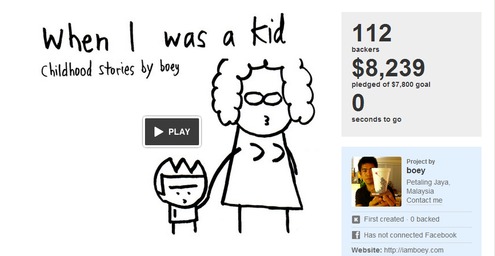
Just the other day, I walked into an MPH bookstore and saw something that looked oddly familiar. It was a book titled “When I was a kid” and I couldn’t help but think I’ve seen this somewhere. It took me a while, but suddenly it hit me–this was the book from kickstarter.

A couple of months back, I wrote a post for a kickstarter initiative by a friend of mine, in that same post, I touched on some other kickstarter initiative from Malaysians. One of those initiatives was by a guy name boey who wanted to write a rather interesting book based on his life. I remember thinking it to be a really unique style of story telling, and I was really thrilled to see it on shelves in Malaysia–but not just because I’m a book lover.

Cyberbullying in Malaysia

Tributes are pouring in for Amanda Todd, a teenager who committed suicide after posting the video above describing how she was tormented by bullies and struggling with depression. Amanda's story was told little by little via post-it notes and it full detail about the extent of the bullying and torment and just how this poor 15-year old girl had experienced her version of hell on earth.

The story isn’t a typical one, but one that exist in a nuance variety even in Malaysia. Amanda was tricked into exposing herself in front of a webcam by an unknown person. Soon she was blackmailed and finally, photos or her were circulated to her entire school. What followed next was every bit as predictable as it is sad, she was ostracized by her friends and tormented by bullies, she even tells of how she switch schools–multiple times–even moving to a school in a different city!!

Yet, the bullies and torments followed here (aided and enabled by social networks), and Amanda must have reached her limit and at some point she eventually chose to take her own life.

Youtube has taken down the videos, but I felt Amanda’s story should be left for the world to see, as a stark reminder to all of us to look after our children, and I just hope you get to watch the embedded video before even this gets removed. I believe out of respect for Amanda–we should listen to the story she so desperately wanted to tell.

[Read more]

Apple’s new Slide-To-Unlock patent : Why it doesn’t matter

Apple Slide to Unlock

Apple was just awarded a 3rd patent for it’s Slide-to-Unlock feature, and while the internet is still abuzz with it, I just fail to see any reason to get excited.

Yes, Apple looks to be greedy and is apparently more than happy competing with HTC and Samsung in courtrooms rather than the open market–but we all knew this already.

Yes, Apple is patenting something so generic it may apply to ALL slide gestures on an unlock screen? – but we all knew the patent system in the US is whacky and open to abuse.

SEO Tips for Malaysian Bloggers

A lot of my search traffic comes from Google, in July I had slightly more than 8,000 visits to my site with just over 6,000 of those coming just from Google. So it made a lot of sense for me to look into some Search Engine Optimization to help boost those numbers. In September, I had more than 10,000 visits with more 8,o00 from Google, which of course begs the question who are the lovely people giving me 2,000 hits/month without going through Google.?

What is Search Engine Optimization?

Search Engine Optimization or more commonly know by it's acronym SEO, is the process of optimizing your site so that search engines like Google know exactly what is on your site, what topics you're writing about and what keywords are present in a page. This allows the search engine to display your site as a result for people searching for topics and keywords most related to your articles.

In Laymans terms it’s making your site understandable for Google to analyze.

Google doesn’t employ thousands of workers to categorize every site on the internet, Google automatically ’tries’ to figure out what your site is about through a mixture of sophisticated algorithms and feedback from search results. SEO is about trying to help Google figure this out by adjusting certain elements of your site to fit what Googles algorithms are looking for, of course SEO isn’t just about Google, but the general concept is the same.