SKMM Study: The Best and Worst Telco in KL

Who doesn't absolutely hate that feeling you get when a call gets drop, or for some reason you just can't seem to make a phone call on your network. Recently an elderly couple in America died while trying to phone for help--they had 9 drop calls in succession, which just goes to show just how important communications are in our time.

Malaysian wireless reports on an SKMM study done in the first half of 2012 to compare dropped and block call rates for the 3 major telcos in Malaysia. At the moment it’s still unclear why neither YES or uMobile have been studied but the study is a move in the right direction towards providing concrete data on call quality for Malaysians to make inform decision about the telco. Incidentally, SKMM also offer a form you can fill if you’ve experienced a dropped call–for some unknown reason the form is hosted on Google Docs, one can only think SKMM didn’t want to fork out cash to host the form  on their own servers.

First off, I’d like to point out that while I can see the report and search for direct links to the PDF version of the reports online. I can’t seem to locate any link to the report from the SKMM website, which is strange, it also appears that only Malaysian Wireless has reported on this particular study. With other blogs seemingly unaware of the study.

In essence, the study is rather simple:

According to the MCMC drive test report, the assessment was conducted with following criteria:

  • Tests were carried out in moving vehicles (Drive Test).
  • Call duration lasts for 60 seconds, with 10 seconds interval between calls.
  • Phones were set on roam-free environment between 2G and 3G networks that simulates the experience of user in making voice call using phone supporting both technologies.
  • The results of the study only reflect the behavior of the networks on the locations and time of the measurements.

Although, the methodology isn’t clear, and there are missing details, the study is a great starting point to confirm if the telco you’re currently on is providing you top notch quality. The 2 key measurements from the study were the drop call rates and blocked call rates, defined as follows:

a. Dropped Call Rate (DCR) Dropped call means a call where a connection succeed, that is, the network is accessed, call set up is successful and traffic channel has been assigned, but is disconnected due to abnormal call release. Dropped Call Rate is calculated based on the percentage of number of dropped call over total number of call attempt.

b. Blocked Call Rate (BCR)  Blocked call means a call is not connected after call attempt due to unavailability of free traffic channel. Blocked Call Rate is calculated based on the percentage of number of blocked call over total number of call attempt.

So the best telco based on these definitions is the one with the lowest DCR and BCR.  A high BCR means calls don’t get connected in the first place, and a high DCR means calls get disconnected once they’re connected. A good telco should strive for the lowest possible numbers on these 2 parameters. While the study was conducted nationally in each and every state, I thought KL would be a good place to dissect the data and provide a benchmark for the nation, if you’d like to know how your telco fared in your home state, head on over to Malaysian wireless who have all the details broken down by state.

[Read more]

Science in Malaysia : Myth #1 Homework

As I read more about the sad state of affairs of Science Education in Malaysia, I can see glaring areas for improvement, and some areas that surprise me. All of this data is readily available in the Trends in International Mathematics and Science Study (TIMSS) that is actually a benchmark our very own Malaysian Government uses to gauge the success of the National Education blueprint. It’s a wonder that while me make it priority to score in the top third of this benchmark, no one for either side of the political divide seems to bother to read the report–merely taking the final score and politicizing it.

If they actually took time off to read even the one report for science–albeit the 520+ page long report. They’d find some rather interesting data.

Take for instance the controversial topic of Homework. There’s a huge Malaysian inclination to load our children with homework, with the noble aim to familiarize themselves with the subject matter and hence improve their test scores.In fact, in all countries surveyed by the TIMSS study, Malaysian students are given the most homework. The MOST!!

Yet we score in the bottom third of the study. Too much homework is bad, but just how much is too much?

The actual data from the TIMSS study, suggest that the optimal amount of science homework to give a child should be no more than 45 minutes per week per subject. You heard that right–in fact, across all the countries in the study, anything more than this and the test scores start to DECREASE.

[Read more]

Malaysia signs ITU

About 2,000 delegates representing major telecommunication industry players, experts and representatives from nearly 200 member countries of the International Telecommunication Union (ITU) assemble here to discuss the International Telecommunication Regulations (ITR) at theWorld Conference of International Telecommunications 2012 (WCIT).

Shouldering the responsibility as a member of the ITU Council for Asia- Pacific, Malaysia is expected to highlight the important issue of telecommunication network security and the right to protect the sovereignty of a country.

[Read more]

LTE in Malaysia has No iPhone5 support

iPhone 5 no LTE support from Maxis Malaysia

Breaking news. That new iPhone that you lined up overnight for outside KLCC–won’t have LTE support, and quite possibly–never will!!

So before you plonk down your dough on the next big thing, you might want to consider how you’d feel if within 6 months everybody else on your block had next generation 4G speeds–except you!

LiewCF reports that :

[Read more]

Does the government have a right to shut down telecommunications services?

Press.Tv reports that Pakistan has suspended mobile phone services in several major cities to prevent terror attacks on minority Shia groups as they celebrate the holy month of Muharram. The rationale behind the suspension is that the terrorist use mobile phone services to detonate bombs and as a result the suspension of mobile phone services would help prevent such attacks. Meanwhile, Ihsanullah Ihsan, a spokesman for the militants’ umbrella group, the Tehrik-e Taliban Pakistan (TTP), has claimed that suspending mobile phone services will not hold them back from carrying out their deadly attacks against the Shia Muslims.

This is ultimately a case of the government having too much power, the real threat of terrorist using bombs somehow resulted in a government issued communications blackout throughout the country–which does little to prevent the terrorist who are hell bent on killing.

I’m guessing that cellphones are picked as detonators for their ubiquity and range, however if you remove the cellphone from the equation you still have hundreds of possible detonation mechanisms, including timers (like the ones from early Mission Impossible shows), walkie talkies and even just a person standing by the bomb and detonating himself with it.

While many of us are of the opinion that a government should do everything to protect it’s citizens, we often fail to to realize that the mechanisms the governments utilize to protect us has a cost–a cost usually paid for by the very people they are supposed to protect.

A full blown mobile service block, doesn’t just block the terrorist–they block everyone. From a father frantically trying to locate his daughter, a hospital trying to locate next of kin in an emergency, or even a blood bank trying to contact its donors. This sort of carpet block is not an effective solution and the cost of it usually far outweigh the benefit, with the benefit being ZERO if the terrorist find some other way to detonate the bomb in spite of the block.

[Read more]

Data guys versus Lawyers and Politicians

Presidential Election predictions

Nate Silver is currently the internet darling of the big data folks, not only did he accurately predict the correct outcome in all 49 states for the US presidential election, he correctly pointed out that Florida would be a toss up before eventually leaning towards Obama. That’s like predicting a coin-toss would end on it’s side. While all of that may seem remarkable, this isn’t a story of a boy-genius but rather the dawn of a new age–an age driven by data.

Nate isn’t alone on this,  The Slate reports that 2 different pundits got the entire analysis spot on as well, not to mention a 3 man team in North Carolina armed only with robo-callers who also made a spot-on prediction. This isn’t some savant ability that Nate has, this is just pure hard core science at work, and the people that use the science are the ones making the accurate predictions, while the people that ignore it–are left behind.

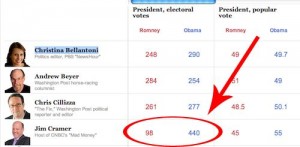
And just who got left behind? The usual opinion writers, like Ann Coulter who predicted Romney would win by a 273-265 margin, Newt Gingrinch who predicted an ever igger margin for Romney and of course Jim Cramer who predicted such a insane number that it probably isn’t even worth typing here–but I’ll type it anyway. Good ol’ Jim predicted Obama would win by a whoooping 440-98 margin, off by more than a 100 point margin…but at least he got the winner right, and I’m sure predicting the stock market isn’t anything like predicting an election, and 100 points means nothing in the stock market.

[Read more]

Anonymous downs Israeli web sites to protest web embargo

[blackbirdpie url=“https://twitter.com/YourAnonNews/status/269572459651555328”]

In what can be described as a great battle for the freedom of the internet, Anonymous – those self-proclaimed hacktivist – have launched a series of attacks on Israeli websites owned by the Israeli Military or Government. The attacks come in the midst of a huge Israeli offensive on Gaza, but contrary to what CNet would have you believe, the attack themselves were not in retaliation to the Gaza offensive, but rather a retaliation to the Israeli ‘threat’ of severing all internet communications in and out of Gaza.

IT Career in Malaysia : Why Information Technology rocks

Number of IT Graduates in Malaysia by Year

So your child has just finish SPM or STPM or A-Levels and now you’re looking at a possible future career for them, or you yourself have just graduated and considering your future career. This is not something to take lightly, after all it’s the 4th most important decision in your life, behind who you get married to, when to have your first child and which EPL team to support. (hint: the answer to last one should start with M and end with anchester united)

Of course, there’s a lot of things to consider when choosing your future career and usually it’s a mixture of passion, interest and future career opportunities.You want a career you like and have interest in, but you also want a career that has future growth possibilities that match your aspirations (do you plan to live in Malaysia or move abroad…etc etc), and if you plan to stay in Malaysia you need to pursue a career that’s growing in Malaysia not something that’s growing somewhere else.

So while it’s great that you like palaeontology and want to contribute to your Tanah Air, but you’re going to be very hard pressed trying to find opportunities for digging up Dinosaur bones in Malaysia. At some point you need to keep certain things as hobbies and find a career that’s offers more progression opportunities. Or make the difficult decision of pursuing your passion somewhere other than Malaysia. It’s a difficult decision obviously, and sometimes you don’t have enough information to make these decisions–but thinking of these things now will save you a lot of heartache later on.

I think we need a lot more engineers and IT professionals in Malaysia, all this talk about transformation from the government isn’t going to happen with lawyers or politicians–it’s going to happen with technology, and unless we have more technically focused professionals entering the workforce, no transformation is going to happen (or at least no ‘good’ transformation).

Unfortunately, not many people seem to agree with me and usually when people don’t agree with me–people are wrong (the only exception to the rule is my wife).

However, I can’t understand had a decline in IT graduates over the last 10 years, and at the same time have an increase in IT opportunities in Malaysia?

A Jobstreet/Pikom report on the ICT industry in Malaysia reports that we’ve gone from 120,000 graduates per year, to just 75,000 graduates per year. That’s a bad sign on so many levels, so today as my little bit of service to the IT community in Malaysia, I’d like to tell you why a career in IT rocks.

[Read more]

Evidence Act: Anonymity before the internet

I read a brilliant article on the Evidence act by Zul Rafique and Partners that I think everyone should read. In it, the author compares the newly amended Evidence Act (supposedly amended to combat the evils of the internet) to a sub-section of the original act meant to look into telegraphs. Now I must admit, that as an internet kid, I don’t quite understand the concept of a telegraph, but the point is that even before the internet Anonymity was possible.

The public perception that is reinforced by ignorant government statements, is that with the internet has enabled anonymity which in turn has enabled crime.

According to Datuk Seri Mohamed Nazri Aziz, Minister in the Prime Minister Department, the amendments were tabled to address the issue of Internet anonymity since this very fact makes it extremely difficult, if not impossible, to trace the alleged offender.

That is a false statement.

Let me introduce you to snail-mail.

In the past, long before the internet was around, people use to communicate via letters and postcards that were hand-delivered by postmen to your doorstep. This is a foreign concept to most children but it’s good to let them know just how hyper-connected they are in relation to their parents or grandparents.

When you send a letter, you write a note on a piece of paper, sign it at the bottom (presumably with your name) and then place it into an envelope. You then write the name and address of the recipient on the envelope, afix a stamp (that acts as a proof of purchase)–and then drop it off at any post office you see fit. The Post Office then somehow routes that letter to the recipient on the envelope–physically hand delivered.

Notice–you never have to prove your identity when you send a letter or postcard. No where in the chain of events are you ever asked for your IC or phone number, in fact I could just as easily write a malicious letter, post it to the Prime Minister and sign it as Datuk Seri Mohamed Nazri Aziz. Would the Prime Minister then automatically assume his cousin sent him the letter just because it was signed in his name?

I guarantee you it’ll be harder for the authorities to trace that physical letter as opposed to a similar digital email. Too many people watch CSI these days to believe that statement, but there’s a reason why kidnappers still use physical constructs–because in the digital world you always leave a trace.

If we apply the amended Evidence Act to the letter analogy, Datuk Seri Mohamed Nazri would be charge for sending that malicious letter to the Prime Minister–even though he never wrote it. All of us understand the stupidity of assuming someone sent you a letter just because the letter was signed by that person, yet we seem to think nothing of it in terms of emails. In fact, if I wanted to get Nazri into a whole heap of trouble, all I’d have to do is send 1000 similar letters to 1000 different people, and sign it with his name–in that way, he’d be charged 1000 different times in a 1000 different court proceedings and even though he might be deemed innocent on each count, it’s still a whole load of trouble I can cause for him for the price of 1000 stamps (roughly Rm500 which wouldn’t pay for even one hour of a lawyers time).

[Read more]

Online Medical books in Malaysia: Unibooks.com.my

Unibooks Malaysia

A rather entrepreneurial friend of mine realized the Malaysia didn’t really have any niche bookstores that offered free delivery. Sure all the medical students knew where to get their textbooks from, and the designers knew where the best design books could be bought–but for the most part that involved a long trip to somewhere to the older parts of KL just to purchase a book or two. For some that may be a worthwhile sacrifice, just like buying electronics from lowyat, but for others that may involve either driving from Penang or even further just to get your hands on a desperately needed textbook at a an affordable price, that seemed a rather big price to pay.

So looking into that gap, he decided to start Unibooks, and what really makes me excited for him is the speed in which he manage to create the startup from nearly scratch and the fact that we’re seeing a lot of local startups flourish to meet the needs of Malaysians–the same needs that seem to be ignored by the bigger retailers.