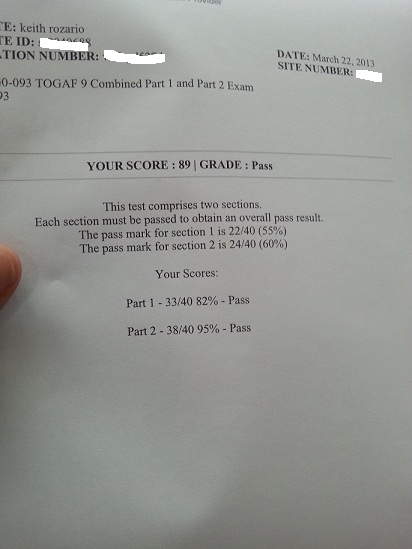
Finally after a year of procrastinating I finally sat for my TOGAF exam. I’m glad I finally did it, but I should have done it much earlier.
A lot of people wonder what TOGAF really is, TOGAF is an acronym that stands for the The Open Group Architecture Framework–yes it’s a mouthful and you’ve probably never heard of it before, but I personally believe architecture is a great place to be in these days, and ever since I moved into solution architecture (slightly more than a year ago) I’ve never regretted it.
Studying for the exam was straightforward enough, and the entire exam takes about 2.5 hours, not bad in comparison for the 4 hour PMP exam or the 3.5 hours for the CCBA. However, where TOGAF slightly differs is the fact that the certification involves two exams, aptly called part 1 and part 2.
Part 1 consist of 40 multiple choice questions, and unlike most other examinations this one has 5 possible options. In my opinion this is actually the harder of the two exams, but this one is a pre-requisite for part 2. If you fail part 1, you go home.
Part 2 consist of 8 ‘complex scenario questions’, which unlike the straightforward questions in part 1 consist of a complex scenario and 4 possible answers. However, the scenarios are quite elaborate AND take time just to digest and read –let alone answer. Once you’ve digested and truly understood the question, there’s still a matter of choosing an answer from a list of 4 possible answers–the only catch is that the answers aren’t right or wrong–there is a gradient to the answers and only the ‘fully right’ answer scores you full marks, the other ‘partially right’ answer score you fewer points. The last thing to note about part 2 is that it’s open book, which is helpful only if you know where to find the information from the 700 page TOGAF documentation.