
Malaysian Cyberwar: Is it an external war or is it civil

The Cyber War between Malaysia and Philippines

A really piece written by Asohan Aryaduray on DigitalNewsAsia some time back talked about how the CyberWar between Malaysia and the Philippines was going on, and how he wanted government agencies to step up the security of our digital assets (or at least start the discussion). Asohan claims that Malaysia perhaps has “the most number of government and quasi-government agencies looking into cyber-security for a country this size; it is time for them to put their heads together and harden the nation’s cyber-defenses.” 

He ends with a rather poignant phrase: It’s war, gentlemen, and it’s time our agencies got cracking.

I’m not so sure it’s war–even less sure we should get the government involved.

If he calls the attacks by Malaysians on Pinoy websites (and vice-versa) a war, then what’s currently going on with the DAP website is a sign of not just war–but a digital civil war, with internal actors, attacking local sites.

TheStar last week reported that the:

DAP has claimed that its websites have been attacked and forced to shut down since last Friday.

National publicity secretary Tony Pua (pix)said the party’s official website, dapmalaysia.org, and its Malay portal, roketkini.com, were incapacitated by denial of service attacks (DDOS) on March 8, 10 and 13.

While TheStar doesn’t report it, but other newsportals claim Pua was blaming political foes for the attack. For the most part this is quite common, we’ve seen Malaysiakini go down a few times, and various other pro-opposition blogs have taken some hits. This of course is even more interesting because Krebsonsecurity.com blogged that he was a victim of not just a DDOS attack but Swatting as well.

[Read more]

Malaysian government using spyware against citizens? No, not really.

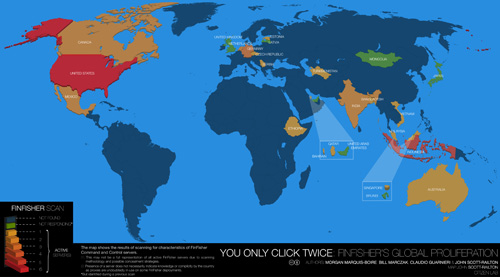
FinSpy server found in Malaysia

I’ve been pretty busy the past few months, and my post count has been pretty low, and although I just returned from a 2 week trip abroad and am now flushed full of work, I decided to burn a bit of the midnight oil today because the Malaysian Insider completely pissed me off.

It all started with an article from Lim Kit Siangs blog, which read “Malaysia uses spyware against citizens, NYT reports”. The post was merely a cut-and-copy reproduction of a Malaysian Insider article that had the same headline. The headline really got my blood churning and it was followed up with an even more mouth watering opening paragraph:

[Read more]

Is the MCMC going to ‘monitor and control’ or is it going to ‘censor’

A week ago, I wrote about the MCMC was planning to ‘monitor and control’ the internet, but just today I looked at my RSS subscription and notice that the Malay version of the press release used completely different words.

While the English version of the Press release used words like ‘monitor and control’, the Bahasa version used the term ‘memantau dan menyekat’. The term ‘memantau dan menyekat’ more appropriately translates to ‘Monitor and Block’ or ‘Monitor and Censor’ rather than ‘Monitor and Control’.

[Read more]

Can Malaysia produce the next Facebook or Google?

Can Malaysia produce the next Facebook or Google?

The short answer is NO.

The longer answer is HELL NO!

One of the things that pushes my buttons is when people talk about how Malaysia can produce the next Google or Facebook like as though creating a world renowned tech brand is like winning a lottery–submit enough entries and you’re bound to win it sooner or later. These people dream, and they dream a lot, from reaching 1% of the global cloud market, developing 5 companies with revenues of at least USD100 million or the most usual dream of them all–for Malaysia to produce the next Google or Facebook.

While all of the nice plushy dreams sound good to a lot of people, the reality is that Malaysia as a far away from realizing this dream as we are from winning the Football world cup–technically it is possible, but no one would be betting money on it (except possibly the Singaporean bookies).

In order to understand how a multi-billion dollar company is created, we can easily re-visit the creation stories of these companies and try to find some similarities that are common across them. So that’s what we’ll do…

[Read more]

MCMC looking to ‘control’ social media at GE13: A worrying trend

Bernama (an official government news channel) yesterday reported that the MCMC is “looking at suitable methods to monitor and control the use of social media in the 13th General Election (GE13)". Deputy Information Communications and Culture Minister Datuk Maglin Dennis D’Cruz said this was “to ensure that the social media would not be abused by irresponsible quarters to achieve their own political agenda”. Datuk Maglin then quickly goes on to shameless promote the BN by saying that “Therefore, the public, especially the young voters should be wise enough to do their parts in selecting the right government with vast experience in managing the country, so that their future will be secured.”

[Read more]

Malaysian parents don’t want Kids to do science

This is so true.

Neil DeGrasse Tyson is probably the most famous astrophysicist  on the planet, and of late he’s been the face of science education in America. He’s got the coolness of Jay-Z mixed with the lovability of Bill Cosby and the intelligence of Carl Sagan all rolled into one. He’s been promoting science in America a lot, and fighting for a budget increase for NASA.

However, he’s pointed out in this video, that the barriers to scientific inquiry don’t lie with our children or our kids, it lies with the adults. Adults that in most cases control budgets and policy regarding science–just like a Minister of ours who suggested we send an astronaut to space to play traditional games. I’ve also noticed this a lot in the past, ever since I wrote about having a career in IT I’ve had more than a few emails sent to me from young people who’d like to pursue IT but face a stumbling block in the most unfortunate places–they’re parents.

[Read more]

Big data in sports

I came across a really cool youtube video from the amazing numberphile series that detailed how companies are already analyzing sports and farming huge amounts of data from sport events like football matches. In fact, these guys are basically farming data from events like the world cup, and then hoping that among that mountain of data lies some insights that could prove useful to football clubs–or football bookies :).

This of course reminds me of the my first glimpse of big data in sports from Moneyball. It was a classic underdog true story that was soon made into a movie starring Brad Pitt (just like every other great true story). I wonder if Football clubs like Manchester United and Real Madrid are using these big data farms to enable some useful analysis.
[Read more]

Mobile Phones at Gas Stations : They’re Safe

Cell Phone usage at Petrol Station

Sometimes good intentions lead to bad things, particularly when they’re not grounded on rational science. Just like how some still believe that Wi-Fi poses a health hazard and even more common myth of how Mobile phones cause gas station fires.

Now that’s a myth that’s been around a loooong time.

No matter whether you call them handphones or cellphones or mobile phones–they’re not allowed in most petrol stations (or Gas Stations) simply because people still believe that somehow these phones can ignite petrol fumes. This is related to the myth that Wi-Fi poses health hazards because Mobile Phones, just like WiFi transmitters use microwaves–and people are irrationally afraid of microwaves.

Microwaves have been getting a lot of bad publicity for the last 2 decades, ever since we discovered we could heat food up with them everyone has freaks out everytime they’re mentioned–everyone except the engineers.

Engineers love Microwaves–they’re the waves that transmit everything from WiFi to WiMax to 3G to HSPDA to LTE, from Astro to Maxis to Digi to Celcom, and we’re constantly bathing in microwaves because everyone uses them–but for some reason it’s not OK to use a Mobile Phone at a Gas Station.

The next time you’re a petrol station, look on the roof, there’s a GIANT ass satellite on it, just bathing in microwaves. That’s a VSAT satellite that most Malaysian petrol stations still use for connectivity.

[Read more]

Are your broadband meters accurate?

Broadband meter caps

When Maxis, or Telekom or Digi claim that you’ve used all your bandwidth quota–can you really trust them? A good article from consumerist reported that even American telcos are facing difficulty counting the bytes their users use.

For the most part this is OK if your ISP provides you unlimited quota, in which case it doesn’t matter how much you use. However, if your ISP is either charging you per byte (like Yes 4G prepaid) or capping your speeds once you exceed a certain threshold, then they’d better be sure that they’re accurately counting the number of bytes you’re using before they starting capping speeds. So if you’ve got a bandwidth quota or a data cap, it’s in your interest to ensure your ISP is measuring your usage accurately, otherwise you could potentially be billed for data you never used.

It’s also interesting to note, that in some cases what the ISP measures as your data usage, is not what you will measure at home. A GigaOm article detailed out Chicago Area Resident, Ken Stox tried to simulate his ISPs metering his own meter at home. Stox installed a Linux application called Tomato, which basically is a Linux program installed on his router that allowed him to write programs to track his usage.

Knox reported on Slashdot that:

[Read more]