
This is how fast your connection on AWS in Singapore is when connecting to a Singaporean server. Not much different if you repeat it, but I was surprised the ping was still 2ms, I expected to be just 1 (or even less).
This is how fast your connection on AWS in Singapore is when connecting to a Singaporean server. Not much different if you repeat it, but I was surprised the ping was still 2ms, I expected to be just 1 (or even less).

WTF is a bitcoin? There’s much ado over the digital currency and many people struggle to understand what it is. In fact, even I haven’t fully grasped the fundamental nature of how it works–but then again I don’t know how the banking and fiat currency system work, yet I still use it.
In essence, there’s been a huge amount of really technical literature written about bitcoin, but most of it is long–really long, and unless you’re prepared to spend a few hours and some mind-numbing amount of effort to digest it, I took it upon myself to distil my knowledge of bitcoin so that you have at least a working knowledge of it.
So here’s bitcoin explained.
On the other hand we have precious commodities like Gold. Gold isn’t regulated by any one central government or bank. The value of Gold is purely a result of the supply and demand in the marketplace, and just like any other precious commodity, part of that value lies it is rarity. It’s rare, and mining it is complex business, so the supply of Gold into the market is controlled by natural consequences.
Gold is valueable because it has value–a currency is valuable because a government says so.
So the best way to think of bitcoin is to treat it as digital gold rather than digital currency.
Well maybe that’s an exaggeration, it’s actually 2 minutes and 1 second!

Let’s first take a step back, and understand how and Internet Service Provider (ISP) like Telekom Malaysia, Maxis or Digi operate.
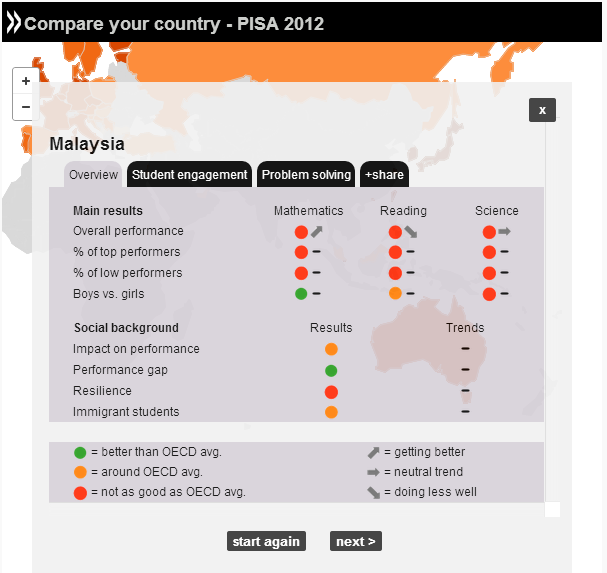
Edweek.org further explains:
The assessment, which was the subject of an Organization for Economic Cooperation and Development (OECD) report released Tuesday, defined creative problem-solving as the ability to “understand and resolve problem situations where a method of solution is not immediately obvious.” Worldwide, a representative sample of 85,000 students took the exam, including 1,273 U.S. students in 162 schools.
As our thoughts and prayers remain with the passengers of flight MH370, I think that as the search enters its 3rd week, it’s a good time to reflect on just how much our perception of aviation technology has changed as a result.
It’s quite important to differentiate between what REALLY happens and what we THINK happens, an in some cases the gulf is so large, that our perception of what happens borders on science-fiction. Take for example, our perception of the US Secret Service. Years of Hollywood movies have led us to believe that if anyone even thought about firing a weapon at the President, Secret Service agents would immediately throw their bodies in the line of fire, evacuate the President and then take out the bad guy. That however is mere fairy tale–no different from the Giant Robots in Transformers or the Aliens in Star Wars. If you look at History and reality, you’d find that some years back, an Iraqi Gentleman not only had the time to throw a shoe at President Bush, but enough time to TAKE OUT A SECOND SHOE and throw it again at the President–were it not for the Presidents quick reflexes, he would have ended looking like David Beckham after a night out with Ferguson.
So the gulf between what we think the Secret Service CAN do, and what it ACTUALLY does, is quite enormous.

Here’s an age old question, is it pronounced router (as in rao-ter) or is it router (as in root-er).
A lot of people seem to think it depends where you are, if you’re in the US, it’s rao-ter, and if you’re in the UK it’s root-er. But the internet is global, it doesn’t care where you are, it doesn’t matter which culture you’re from, there can only be one answer to this question, and it must be location agnostic.
Tun Dr M, our beloved former Prime Minister, openly supports Israel–well sort off.
Today on his blog chedet.cc, he called on everyone to boycott Israel, stating quite clearly in his latest post that;
I think the whole world in the interest of justice should boycott doing business with Israel. This is truly a pariah state which is immoral and beyond the pale of human laws.
Now of course, you’re wondering if Tun Dr M supports Israel or not? Well in actual fact it’s both, because while his words say he opposes Israel, his actions, specifically those of his website suggest otherwise.
Internet users in Malaysia were reporting issues trying to access a specific page on the BBC UK website that was a hilarious post making fun of our ‘beloved’ Prime Ministers Kangkung remarks. Apparently the issue became so bad, that users took to social media –only to find that they were not alone. In fact, so many Malaysians were complaining that they couldn’t access the post, that the official twitter handle of the BBC News tweeted to its followers asking them if they had issues.
Are you in #Malaysia? Can you access this BBC story about #kangkung? http://t.co/sDKN4fFWyV - let us know using #BBCtrending— BBC News (World) (@BBCWorld) January 16, 2014
Now, I for one, experienced no such disruption–but then again I use a VPN, and quite frankly, so should you!However, there are a couple of things you need to know about internet censorship, and this debacle in particular.
Let’s be honest–Malaysians watch a lot of Porn.
On the outside, we may espouse our ‘Asian’ values and culture, but the cold-hard data suggest we’re as horny as the Japanese. In one of my past post, I showed how we have evidence of someone using the Government internet connection to download porn.
Today however, PornMD the self-proclaimed “biggest porn search engine” released statistics as to what Malaysians were searching on their site. The results aren’t that surprising, although I was quick shocked to see Tudung on there–apparently some people find it kinky.