A Techie’s view on the Law

2283584007_f199332890_z

Are some laws worth following–in other words, are some Laws so idiotic that they should be ignored completely?

That sounds anathema, because we have a romanticized definition of the law, we define the Law as a broad general agreement a society undertakes, and the law keeps society from tearing itself apart. In other words, the law is so sacred because without it–we descend into anarchy, so ignoring the law is akin to promoting anarchy.

But I’m not speaking of “The Law”, I’m speaking of “A law”, specifically an Act of Parliament. “The Law” refers to a vast conglomeration of many things, including constitutions (state and Federal), statutes, precedence of case law and Acts of Parliament. I’m not sure what a statute is–but I roughly know what an Act of Parliament is, and it surely isn’t a broad general agreement that society depends on to stave off Anarchy–rather an act of Parliament is a law brought into effect by Parliament–nothing more nothing less.

To my techie mind, that means that 222 Members of the Malaysian Parliament got together to enact a piece of legislation. Romantically we think this is the people’s will–the Rakyat voted these people into power and they now wield this power to enact laws that will protect the Rakyat. A glorious cycle of virtuosity that only democracy can deliver. That’s wishful thinking, realistically it’s a law brought into effect by 222 voting members of Parliament whose collective IQ would probably not exceed that of the Zoo.

So when these 222 MPs ge t together and enact legislation to regulate technology–I get a bit uncomfortable. Not only do most of them not have engineering qualifications, half of them don’t even have a website. Having these MPs enact legislation that will regulate a field they’re clueless about, is akin to getting open heart surgery from a car mechanic.

On a side note, a techie like me has a hard time understanding why we have 222 seats in Parliament. It would seem, that in a first past the poll system, you’d want to have ODD number of seats, to avoid the situation where 111 members belong to Barisan, and the other 111 belong to Pakatan (what happens then?). That’s just ONE of the many things an engineer would quickly realize is wrong with the entire system–and that’s why we only have 3 engineers in Parliament (at least according to the Sinar Project).

[Read more]

Nearlyfreespeech the hosting provider that takes security seriously

NearlyFreeSpeech.NET Web Hosting

You all know how much I love nearlyfreespeech, it’s one of the best hosting providers out there. Here’s one more reason, recently they alerted me to a suspicious number of login attempts to my wordpress site, which usually means someone was trying to hack it.

If you remember the post I did about the RHB bank scam, it’s quite common for hackers to inject pages onto a wordpress site to help them carry out banking scams. This was probably something similar.

Fortunately, the guys over at nearlyfreespeech were not just kind enough to log the attempts and alert me, but even automatically disabling the login page of the site to prevent something similar happening. Good on them!

Nearlyfreespeech is a great hosting provider and this just proves my point. Check out the email below:

[Read more]

Why the ban on Uber means more than just Taxis

Uber in Malaysia

Uber, a company that connect passengers with drivers of vehicles for hire and ridesharing services–is now banned in Malaysia. The Uber service was viewed as a god-send by citizens of KL simply because the existing taxi service in the city–is Shit!

So why did the Government choose to ban a service, that was improving public transport in KL? For the small matter that it violated a couple of laws–no big deal really. Laws are made to be broken aren’t they?

There’s no need to go into the details of whether Uber is legal or illegal, that’s an irrelevant point. Even though the cars Uber offered were far safer and more comfortable than any other Taxi on the roads in KL–it probably couldn’t get the necessary licenses if it tried. In other words–it couldn’t legalize itself. But that’s a mere side-note to this whole debacle, the real problem is how Malaysia handles disruption.

Uber is a disruptive service that was on the verge of changing the way Malaysians view public transport–but some people in high places may not have liked that. To me as a techie I can’t understand the reason for any of these laws–in fact at its core ‘The Law’ is a piece of technology. But the people drafting the law, MPs in Parliment aren’t even well versed in things like the internet, let alone these disruptive technologies which requires new laws to regulate.

If we are to be a developed nation, we need to embrace disruptive technologies, because that’s how we innovate, and at some point all innovation requires someone to break the law, because the law can’t foresee disruptive technology–that’s almost by definition. We can’t realistically expect the politicians to keep up with technology, let alone draft legislation to regulate them. And every new piece of legislature put out by politicians very quickly reaches the boundaries of it’s effectiveness the moment new technology becomes available.

Consider the following:

[Read more]

What do ISIS and Genghis Khan have in common?

[caption id=“attachment_4535” align=“aligncenter” width=“475”]

Image courtesy of www.breitbart.com

Image courtesy of www.breitbart.com[/caption]

I thought I’d take a break from writing about Tech this week, to focus on where the worlds attention should be–Iraq and Syria, and the existential threat that is besieging the middle-east, a threat we’ve come to call The Islamic State of Iraq and Syria (ISIS).

ISIS may have started of an off-shoot of Al-Qaeda, but they’ve evolved to be much more, they’re so far removed from the Al-Qaeda of Osama Bin Laden they’re starting to look like an reincarnation of an much for terrifying ancient enemy. An enemy that 700 years ago threatened the very existence of Islam in the Middle East more than Israel ever could today. ISIS might be just be the next–Genghis Khan.

You might scoff and laugh, but there are many things strategically and tactically that make ISIS look like a direct descendant of Genghis Khan, and there were many contextual similarities between what’s happening now in the Middle East, and what was happening 700 years ago when the Mongol Horde descended upon it.

The Mongols are the exception to all of history, for example they’re the only people to have invaded Russia in the Winter–and WON!, and they invaded Afghanistan on horseback–and WON!

Historians will glorify them, but we know better. At its peak the Mongol armies controlled more land than anyone before them , but they won their battles in vile, vicious and cunning ways and what they did to their captives is unspeakable. Truthfully the Mongols (and specifically Genghis Khan) were Assholes of the highest order–but they weren’t the only Assholes in history. Alexander, Napoleon, Attila–these were all assholes, it’s just that the Mongols won more wars giving them more opportunities demonstrate their asshole-ness.

Of course the Mongols weren’t just assholes, they were phenomenally great Military Tacticians and Strategist. Almost everything they did (apart from binge drinking) was for the sole purpose of winning wars and battles–even their rapes and terrorizing served to aid them in victory over the enemy (and we’ll soon see how).

But when you dissect as to why the Mongols were so successful–you’ll soon realize it’s the same reason ISIS is so successful, and the similarities between ISIS and the Mongols are too shocking to ignore.

[Read more]

Is illegal downloading considered stealing?

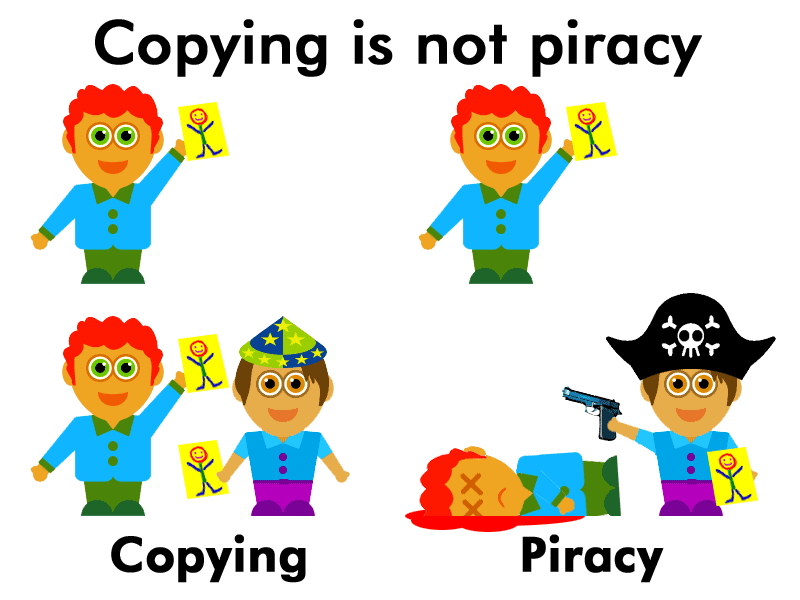
copying_is_not_piracy

There’s a general perception that illegal downloads of movies, music or books is akin to stealing the works of the artist, singers and authors. But downloads are more akin to trespassing than it is stealing–they’re nothing like stealing and if you take some time off to think about it, you’d figure this out too.

When you steal something, you’re denying the victim something,if you steal my car, you’ve taken something from me that I can no longer use. Stealing is a zero sum game, where the perpetrator gets something, and victim loses something. Obviously stealing is bad, but downloading isn’t stealing.

When you illegally download music, you’re not denying anyone else something physical. The music that you downloaded is still on the server you sourced it from, all you did was make a copy. Illegal downloading, isn’t zero sum, you profited (maybe),but no one lost anything of value. And so the rules that we devise for digital information (which can be replicated freely) shouldn’t be the same rules we apply for physical items like cars, and gold coins (which can’t be replicated freely).

Of course, the argument is that illegal downloads deny the content creators income they rightfully deserve, but that’s only true in a handful of cases. If someone refused to sell you their content regardless the price you’d be willing to pay–does it then make it morally wrong for you to download the material? You cannot consider it a loss for the content creator if they never intended to sell the item to you in the first place.You cannot deny income to someone who refuses to take your money, so therefore an ‘illegal’ download isn’t stealing at all.

And it doesn’t stop there. What happens if the content creators are just plain jerks–would it be morally wrong to copy their digital data–and would that be considered stealing?

[Read more]

CheDet on Censorship

Tun Dr. M

Tun Dr. Mahathir now says he’s change his mind about internet censorship. To quote him “Not knowing the power of the Internet, I promised that we (speaking as the Prime Minister of Malaysia) would not censor it. But today I have changed my mind."

Of course, everyone has a right to change their mind–but in this case Tun went from being absolutely spot-on (the internet doesn’t need censorship) to dead wrong.

[Read more]

Who are you trusting online?

Trusting in an online world

When you get behind the wheel of your car, and hit the road–you’re implicitly trusting ever other road user to play by the rules.  You trust no one will go out of their way to crash into you, or that no one would swerve into you for an insurance claim, you even trust that pedestrians won’t hijack your car as you stop at the red light.

Sometimes you mitigate these risk, by locking your doors and keeping your distance, but fundamentally you’re placing a lot of trust on your fellow road-user. You have no way of knowing for sure that they’ll be good boys and girls–but you go about your daily car ride trusting that they’ll do what is right. In cases where you don’t trust anyone, you don’t use the road. I know a lot of people who won’t drive in India because they don’t trust road users there–and some foreigners refuse to drive in Malaysia for the same reason.

Society works on trust, and without it–society just wouldn’t work.

Think about it–you might not trust the restaurant waiter with your credit card–but you just ate at the restaurant without viewing the kitchen. Dying from poisoned food is far more serious than credit card fraud, yet you’ve trusted the restaurant not to poison you, but not with 16 digits from your bank. Sometimes you’re trusting people without even knowing it.

And the same is true for the internet, The Internet Protocol(IP) that governs the whole internet till this day, is a highly ’trusting’ protocol that prioritizes speed and simplicity over security and privacy. In much the same way that it’s faster and simpler just to trust the restaurant not to poison you than it is to inspect the kitchen and verify the ingredients–the Internet Protocol accepts everything as true and routes data accordingly. Other protocols like SMTP and POP3 that are used for email employ the same levels of trust, that’s why you can never trust an email–it’s just too easy to spoof.

Essentially everyone on the internet trust everyone else to play by the rules. For example when Pakistan decided to block youtube in their borders, a mistake made by their local telecoms managed to take youtube down for several hours worldwide simply because everyone trusted the information Pakistan was sending them. Nowhere else in the world does such a high level of trust exist as on the internet–and nowhere else is it more dangerous.

[Read more]

RHBNOW Email: Intricate details of a Phishing scam

Last month alone I’ve received 6 phishing emails asking me to change my RHB banking password. I always wondered what would happen if I’d actually clicked on one of the links in the email–and today I did just that. Immediately I was transported to a dodgy world of sophisticated deception, and soon realized this was far more complicated that I initially expected.

Before I proceed a friendly word of caution–Kids don’t try this at home–the scam is an elaborate ploy geared towards robbing you of your cash, and if you’re not sure what you’re doing–chances are you’ll be a victim yourself. The simplest way to avoid a scam like this is to never click on an email from the bank–regardless of how genuine it looks. Banks never send you email–so don’t expect one from them. Not even a Christmas card.

But if you’d like to see what happens when you click on one–read on:

Step 1: The email from RHBGroup.com

Email from RHB Group

First there’s the email, it was (supposedly) from sshccserv356@rhbgroup.com. Quite deceptive, and if you visit rhbgroup.com you’ll find that it’s the legitimate RHB Bank website. So it appears this email from rhbgroup.com would be legitimate as well.

Except it’s not.

Email is a remnant of the internet past–it was created at a time when security wasn’t a priority, hence Emails lack any form of authentication (validating whom the email is from) which allows them to be easily forged. This inherent insecurity is what Emails should never be trusted, especially when those emails come from external sources like a bank.

That’s why your bank will NEVER send you an email. It’s too easy to forge. So rest assured that every email you receive from the bank is a fake (there are exceptions of course, like transfer notice etc, but those emails don’t require any action from your end)

Analysing the email further, I find the first victim of the scam. A website called pjpan.co.uk, a pajama-store (of all things). The website url was all over the email-header, which just like every other aspect of the email could be spoofed. Why the scammers chose to us pjpan.co.uk was beyond me, but they did. In any case the email was sufficiently obfuscated that trying to determine its origin would be difficult and probably pointless as well. 

[Read more]

Youtube Video flagged as inappropriate

Last week one of my most popular videos detailing how I hacked Unifi accounts was ‘flagged’ as inappropriate in YouTube–apparently it was in violation of their community guidelines.

As such my video was made unavailable and essentially deleted from Youtube.

I was upset.

The email I received from YouTube, gave no indication as to what I did wrong, and even though it states that someone have viewed my video, the language used suggest this was just an automated message sent to my inbox. Nowhere does it suggest an actual human viewed my video and made a judgement, and even worse no justification was given for the removal of the video other than it was ‘flagged’.

Regarding your account: Keith Rozario

The YouTube Community has flagged one or more of your videos as inappropriate. Once a video is flagged, it is reviewed by the YouTube Team against our Community Guidelines. Upon review, we have determined that the following video(s) contain content in violation of these guidelines, and have been disabled:

Everyone hates spam. Misleading descriptions, tags, titles or thumbnails designed to increase views are not allowed. It's also not okay to post large amounts of untargeted, unwanted or repetitive content, including comments and private messages.

Your account has received one Community Guidelines warning strike, which will expire in six months. Additional violations may result in the temporary disabling of your ability to post content to YouTube and/or the permanent termination of your account.

For more information on YouTube's Community Guidelines and how they are enforced, please visit the help center.

Please note that deleting this video will not resolve the strike on your account. For more information about how to appeal a strike, please visit thispage in the help center.

Sincerely, 

The YouTube Team
[Read more]

3 Ways to watch Netflix from Malaysia

Netflix is awesome. I watch it everyday, and while the selection is dated–it’s still pretty good.

If you needed proof for just how good it is–32% of all internet traffic in the US, belongs to Netflix. There’s two problems though. First, it isn’t free, and cost about Rm30 month. Not really and issue since Rm30 on Netflix gets you a lot more content than the RM100+ you spend on Astro.

The second problem is that it’s not available in Malaysia. So even if you were willing to pay the cash, you couldn’t get Netflix streamed to your home–until now that is. So here’s 3 ways to stream Netflix, BBC iPlayer and even DramaFever (for the k-drama fans out there) to your home in Malaysia.

[Read more]