Using the internet anonymously

Spying Program

While anonymity on the internet is slowly dying, there remain legitimate reasons for wanting to keep your online identity a secret from those meddling kids, governments or snooping criminals. From e-mailing leaked documents to commenting on blogs using pseudonyms or even just casual online chatting, utilizing the internet without leaving digital bread-crumbs behind you is a task that is getting more difficult over time, particularly when the big bad wolf that’s chasing you down is a rich and powerful government agency.

But to secure yourself online, you first need to understand whose attacking you, and what techniques they’re using. Adjusting your defense to suit your attacker is not just common sense, it is the only practical way to achieve a semblance of security and anonymity online without losing your mind and going into tin-foil hat wearing paranoia.

For example, if your adversary is the NSA, there’s nothing much you can do. This is a Federal agency so well resourced, they’re building a data-center in Utah that’s bigger than 5 Ikeas.Add to all this, the fact that it hires the cream of the crop from the Ivy-league maths programs, and you have brains and brawn that are orders of magnitude higher than the average person. If the NSA wants to target you, it’s game over. The only reason you’re not targeted by the NSA is that you didn’t factor high enough on the wanted list to merit their attention and taxpayer dollars.

But how about the Malaysian Government? How sophisticated are they and is it Game-over if the Malaysian government were targeting you?

Fortunately, our Governmen isn’t building a Utah data-center, or a Great Firewall and they’re no where close to the NSA, but they’re still a well-resourced organization that has the technical capability and financial muscle to do some serious harm against an ordinary citizen. And in order to secure yourself against them, you’d need to understand their techniques and tools.

Malaysian Government Surveillance 101
Childrens Privacy

Firstly, the government controls the ISP and Telcos, and hence the Government controls the network. The prevention of terrorism act (POTA) permits a Police Officer to waltz into any ISP or Telco and compel them to grant him your communication details without the need for any kind of judicial warrant, it also allows for the Police to place a digital wiretap on your communications (again without a warrant), but also without ever having to reveal the status of that wiretap to any court of law even if they convict of something. So anytime you’re using a Malaysian internet connection, you have to assume that the connection is compromised.

Thankfully, whenever I go into a starbucks, or use the WiFi at KLIA, I already assume the network is compromised–and there’s many ways to secure yourselves over a hostile network.

Secondly, the government has a record of purchasing surveillance spyware (twice!),  These are specialized software designed to infiltrate your laptop or smartphone, and start sending all your communication data direct from source. Again, one has to assume there is no judicial oversight over the use of these things.

If your end-device is compromised, and the Government has already installed spyware on your phone, laptop, tablet or even smart TV, there’s nothing you can do on the network end to secure things. So it’s wise to start securing the device before you think about the network, and that’s where we’ll begin.

But there’s a last and final attack-vector that a government can employ. Simply breaking into your home, and taking your laptop and smartphone away from you. Which means that you don’t just need to secure your device and network when you’re using it, but also when you’re NOT using it. In computer-geek circles we call this securing your data at rest, which protects your data while it’s just idling somewhere, and it turns out that’s not entirely easy to do either.

[Read more]

Change WiFi password on Maxis home fiber router

Got Maxis Fiber to your home, but want to change your WiFi passwords, then here’s how you do it.

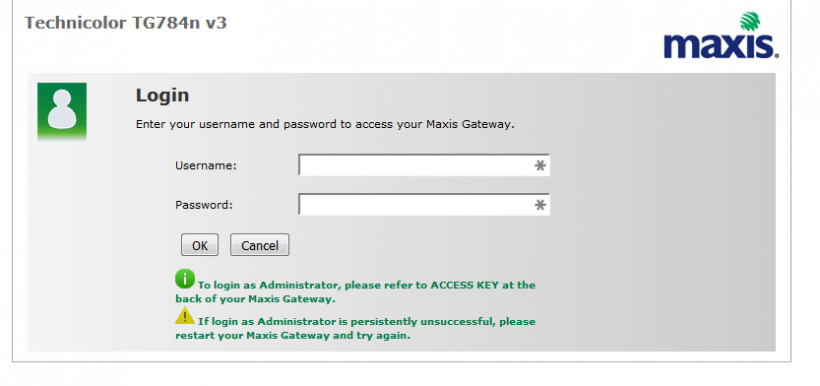
Image-1-Maxis-Logon

First you need to logon to your router. You can do so by opening your Web-Browser and type http://192.168.1.254 (where you’d normally type google.com), or just click here.

You should either see a picture like the above, then you’d need to enter the username and password, or if you haven’t setup a router password, then you’d see this:

[Read more]

A dumb-pipe and Net Neutrality

The pipe that brings water into your home is a pretty un-sexy thing, just like the electrical cables that deliver electricity. Your internet connection though, has gotten sexier and sexier–from being used to deliver paid content like hyppTV and Astro to other more interesting services, resulting in a triple play (internet, tv and phone) of services, all piped into your home on a fibre optic cable no thicker than a strand of your hair.

But should you internet connection be sexy or should it be a dumb-pipe? The telcos of course want to deliver more services and hence fatten the bottom-line, but the problem I have is that in their zeal to do this, they’ve violated the principles of net neutrality, and I fear that we’re going down a rabbit-hole of ‘favored’ content, that sooner or later we’re not going to be able to reverse this trend.

A quick example is Maxis, it’s the only player out that can stream Astro content over the Fibre cable. That gives Maxis an un-fair advantage over TM.

[Read more]

Block This!!

A notice posted on the Malaysian Communications and Multimedia Commission’s (MCMC) Facebook page said the decision was made to block websites that “promote, spread information and encourage people to join the Bersih 4 demonstration”, on grounds that this will “threaten national stability”.

I cannot then tell you to join Bersih and call for free and fair elections, and I couldn’t begin to articulate that our Prime Minister has received BILLION ringgit donations from foreign sources, and certainly I must refrain from encouraging you to do your civic duty to attend tomorrows rally.

[Read more]

Why we fear ‘hackers’: Dangers of Technical Illiteracy

anonymousmask380-300x225

Are you afraid of Hackers? Do you lie restless at night thinking of what might happen if they got into your bank account, facebook profile, or e-mail. Perhaps you’re also worried about that they might hack into a forum you visit, or that they might get into your personal messages on whatsapp.

It’s true that hackers are able to do all of these things, but the public perception of hackers really isn’t quite justified, and this false perception can lead to terrible outcomes.

Take last weeks post about the hacktivist group Anonymous. In it I expanded on the public fear of anonymous and how that didn’t correspond to the actual damage that the group causes. Sometimes all Anonymous does is a DDOS on a public website, that still takes some skill, but far removed from actually infiltrating a server. Yet, most people wouldn’t be able to differentiate a DDOS attack of a website to a compromise of an actual server, and this inability leads then to disproportionately fear hackers, worse still it leads them to lump all security related incidences into a single bucket called “hacked by hackers”.

But Why?

Why are people so afraid of hackers? And why is there a huge discrepancy between what some of these hackers are actually doing and the fear that the average citizen has of them.

I have one theory–ignorance, or more specially tech-illiteracy.

[Read more]

Our Communication Minister must be mistaken

Our newly appointed Communication Minister has come out all guns blazing in directing the The Malaysian Communications and Multimedia Commission (MCMC) to ask social media giants such as Facebook, Google and Twitter soon to block “false information and rumours” on their platforms.

That in itself is quite frustrating, but what really got me scratching my head was his claim that “that social media providers acted on 78 per cent of MCMC’s request for removal of content last year, with Facebook taking action on around 81 per cent of its request.”

[Read more]

Understanding Anonymous from a Malaysian context

anonymousmask380-300x225

The latest buzz in Malaysian cyberspace is the ’threat’ from Anonymous Malaysia to launch ‘internet warfare’ on the Malaysian government, singling out our poor ol’ Prime Minister, demanding that he step down or face the consequences of Anonymous actions.

The threat of internet warfare even came with a date, 29th to 30th August at 2.30pm, coinciding with Bersih 4.0. You know you’re dealing with a bad-ass when they tell you when the attack is coming, sort of like Muhammad Ali telling his opponents which round he would knock them out in. (down in the 5th)

[Read more]

We need a change in Government

I need to take this blog to somewhere it hasn’t been. To boldly go where every other Malaysian blog has already gone–into politics.

This is my blog, it’s my hobby, I don’t depend on it for my survival, I don’t rely on it for anything other than the satisfaction it provides me. Therefore, I get to do with it what I want, and today I want to talk about politics.

[Read more]

TM blocking SarawakReport

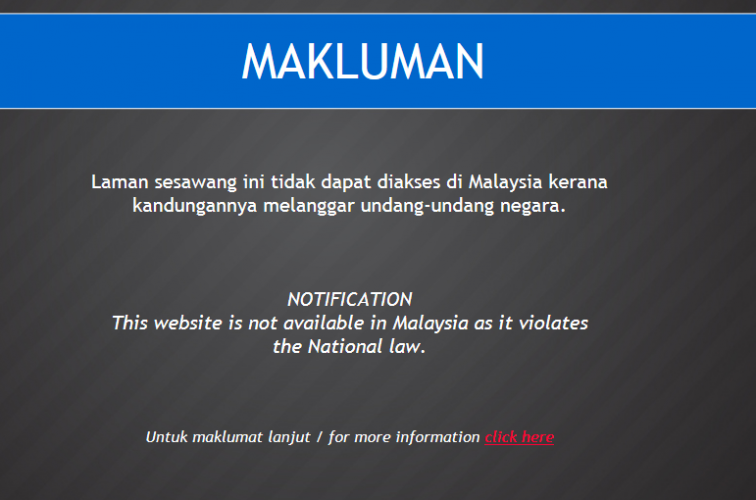
Website Blocked

Sarawakreport, a website covering sensitive political topics in Malaysia was blocked today by the countries most prominent ISP, Telekom Malaysia (TM).

Internet users using TM’s Domain Name Server (DNS) reported that the website was inaccessible, and I’ve confirmed that is an intentional block by TM.

Here’s a quick primer on DNS. The internet works on this marvelous set a rules we’ve come to call the Internet Protocol. Part of this protocol requires that every server or machine on a network be assigned a unique number to identify itself, this number is called an IP address. An IP address is sort of the phone number of a server, and if you want to communicate with a server you’d need to know that servers phone number.

[Read more]

Hacking Team got Hacked, and here’s what Malaysia Bought

[caption id=“attachment_5085” align=“aligncenter” width=“550”]

RCS monitor

A screenshot of the RCS Software from Hacking Team[/caption]

There are two types of governments in the world, Those that build complex surveillance software to spy on their citizens, and those that buy them–and our government is more the buying type.

Few nation-states have the budgets to build out complex surveillance software, but some are finding that ‘off the shelf’ software sold by dodgy companies are just as effective at a fraction of the price. The problem with buying of course, is that sometimes those dodgy companies that are manufacturing these spying software also sell their wares to repressive regimes like Sudan, and being on the same customer list with Sudan doesn’t quite bode well for any ‘moderate’ government.

Take Gamma Corp for example, the organization responsible for the FinSpy and Finfisher suite used by the Malaysian government in the run-up to the 2013 General elections. Another is Hacking team, an Italian based company that produces similar remote control software (RCS).

And in a bit of internet karma–both of these companies were hacked themselves…possibly by the same person.

In August 2014, Gamma was hacked and had 40GB of data forcefully exfiltrated from their servers. My analysis of that leak, revealed no information about Malaysian purchases of their FinSpy software simply because a large chunk of that data was encrypted.

Recently however, Hacking Team had a much more severe attack, one that managed to extract 10 times more data, and here I found ample evidence of Malaysian government agencies procuring spyware from Hacking Team presumably to be used against Malaysians.

The question of course is should you be worried, the answer is Yes, and not just for the obvious reasons. After combing though a trove of documents, I found that 3 government agencies procured the ‘flagship’ RCS software from Hacking team, and from my layman’s understanding of the law, none of them have authority to actually use it.

Worst still, some e-mails point to incompetent IT skills as well as bad Procurement practices, that actually annoyed hacking team’s salesforce. I will conclude this post with why this attack on Hacking Team has a positive outlook for regular internet users, and why our government agencies procuring this stuff isn’t exactly ALL THAT BAD.

[Read more]