Identity in a Post-Breach world (draft)

Posting this here first, my thoughts to follow. Random thoughts below are draft :).

Random thoughts on the matter

  1.  We still need a single identifier in Malaysia (IC Number), this is administrative necessity. LHDN needs to check your bank accounts, Election Commission needs to know you're not double-voting..etc.
  2. But that single identifier should not be used as an authenticator. No one should ask me for my IC number as a means of authenticating myself. When I call the bank, they shouldn't be asking me for my IC number as a means of proving my identity to them.
  3. There's too much info in the IC number (age, state, gender). Take all of that out, and replace with a random blob of numbers -- one that cannot be guessed as well. So something like 8 numbers and 4 letters large enough, so criminals can't guess.
  4. We need 'identity-freezes' in Malaysia. In America you can freeze your credit, but in Malaysia we need to go a step further and put an Identity freeze, especially for internet services.
  5. Check out section 114(a) of the evidence act, wrongly registered phone numbers are a thing, and they're bad. If someone registered a pre-paid account in your name, and posted something bad -- you'd be in trouble.
  6. If you took a loan from Maybank to buy a house, and 1 year later defaulted on the loan, no other bank in the country would grant you a loan. This protects the banks from issuing credit to someone who can't pay back. So we have credit freezes.
  7. Let's use the same mechanism to allow people to lock their identities, so no one can open bank accounts, telco accounts, not even Astro, TNB or Indah Water as long as the identity is locked. This way, the value of a stolen identity is tremendously reduced, and we protect breached victims.
  8. Identities can be 'un-freezed', e.g. when you buy a house, but then re-freezed shortly after.
  9. More thoughts to come.....
[Read more]

Sayakenahack: Epilogue

I keep this blog to help me think, and over the past week, the only thing I’ve been thinking about, was sayakenahack.

I’ve declined a dozen interviews, partly because I was afraid to talk about it, and partly because my thoughts weren’t in the right place. I needed time to re-group, re-think, and ponder.

This blog post is the outcome of that ‘reflective’ period.

The PR folks tell me to strike while the iron is hot, but you know – biar lambat asal selamat.

Why I started sayakenahack?

I'm one part geek and one part engineer. I see a problem and my mind races to build a solution. Building sayakenahack, while difficult, and sometimes frustrating, was super-duper fun. I don't regret it for a moment, regardless of the sleepless nights it has caused me.

But that’s not the only reason.

I also built it to give Malaysians a chance to check whether they’ve been breached. I believe this is your right, and no one should withhold it from you. I also know that most Malaysians have no chance of ever checking the breach data themselves because they lack the necessary skills.

I know this, because 400,000 users have visited my post on “How to change your Unifi Password”.

400,000!!!

If they need my help to change a Wifi password, they’ve got no chance of finding the hacker forums, downloading the data, fixing the corrupted zip, and then searching for their details in file that is 10 million rows long – and no, Excel won’t fit 10mln rows.

So for at least 400,000 Malaysians, most of whom would have had their data leaked, there would have been zero chance of them ever finding out. ZERO!

The ’normal’ world is highly tech-illiterate (I’ve even talked about it on BFM).  Sayakenahack was my attempt to make this accessible to common folks. To deny them this right of checking their data is just wrong.

But why tell them at all if there’s nothing they can do about it? You can’t put the genie back in the lamp.

[Read more]

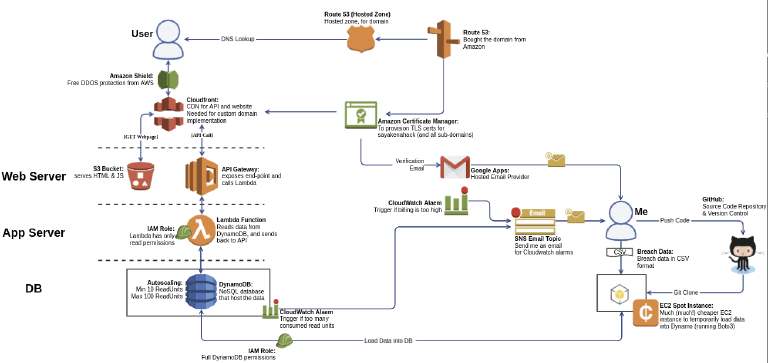
Sayakenahack architecture

I know the picture is a bit hard to read, but I wanted to make sure I had a detailed enough picture to understand the ‘innards’ of sayakenahack. Sometimes when you’re building stuff on the fly, and bottom-up, it’s good to take a step back, and have a top-down view.

I’ll be expanding this post over time, wanted to get my thoughts down quickly on paper before I moved on.

[Read more]

Sayakenahack.com answering the questions

OK, this is my last post on sayakenahack.com, and I’ve got a script scheduled to run at Sunday midnight to tear down the database. So if you wanna check, you better do it now, cause in 3 days time, it’ll be gone.

poof

But here are my thoughts on this whole debacle – and it’s going to get emotional, so don’t say I didn’t warn you.

So let’s start with the basics.

[Read more]

Why does SayaKenaHack have dummy data?

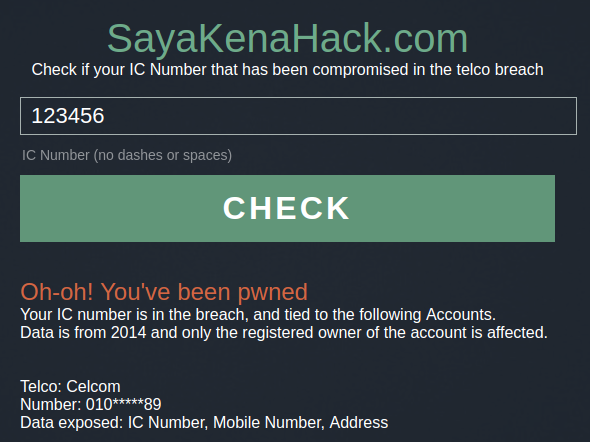
Why does sayakenahack have dummy data? If I enter “123456” and “112233445566” I still get results.

I was struggling with answering this question, as some folks have used it to ‘prove’ that I was a phisher. We’ll get to that later, for now I hope to answer why these ‘fake’ IC numbers exist in the sayakenahack.

Firstly, I couldn’t find a good enough way to validate IC numbers as I was inserting them into the database. Most of you think that IC numbers follow a pre-define pattern :

  • 6-digit birthday (yymmdd format)
  • 2-digit state code
  • 4-digit personal identifier, where the last digit is odd for men, and even for women.
But, there are still folks with old IC numbers, and the army have their own format. Not to mention that the IC Number field  can be populated by passport numbers (for foreigners) and Company registration IDs. So instead of cracking my head on how to validate IC numbers, I decided to pass them all in.

The only ’transformation’ I do is to strip them of all non-AlphaNumeric characters and uppercasing any letters in the result. This would standardize the IC numbers in the database, regardless of source file format.

Had I done some validation, I might have removed these dummy entries – but fortunately I didn’t.

Upon further analyzing the data, I went back to the original source files and notice something strange, the account numbers belonged to some strange names. And then it made sense – this was Test data.

Test data in a Production Environment to be exact.

And when the Database for the telco was dumped, the telco’s didn’t remove these test accounts from their system. So what we have is a bunch of dummy accounts, with dummy IC numbers.

[Read more]

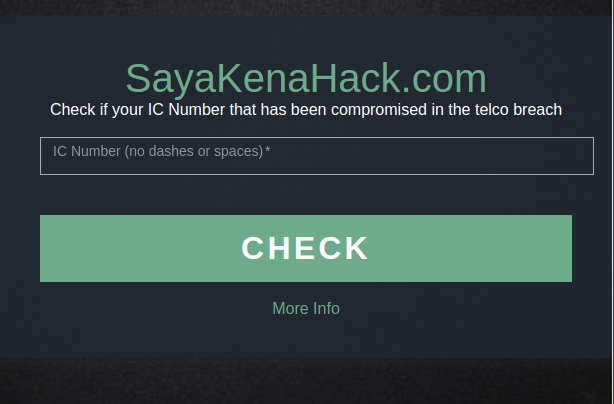
SayaKenaHack.com

On the 19th of October, Lowyat.net reported that a user was selling the personal data of MILLIONS of Malaysians on their forum. Shortly after, the article was taken down on the request of the MCMC, only to put up again, a couple of days later.

Lowyat later reported that a total of 46.2 Million phone numbers were exposed,  and the data included IC numbers, Addresses, IMSI, IMEI and SIM numbers as well. In short, a lot of data from a lot of people.

[Read more]

#PotongSteam

I haven’t blogged in a while because I’m busy studying (yes, studying) for my OSCP certification.

But what happened over the week, was just to mind-blowingly stupid to ignore.

Here's what happened....

A Taiwanese company released a game titled Fight of Gods, which as the name implies, has Gods fighting among themselves. But the developers didn't 'just' use Greek, Roman or Norse Gods -- they went a step further and used Jesus and Buddha (but not Muhammad or Allah). Gods fighting among themselves isn't anything new in videogames or comics, who do you think Thor from the Avengers is based on, or Hercules from Disney, or just watch any Justice League episode with Wonder Woman, the real difference here is that games don't typically use Jesus or Buddha.

Most gamers brushed off the game as a lousy game wrapped in a theatrical package, but the media picked up the story and the game garnered more publicity than was warranted. So much publicity, that the Malaysian government decided to take action, but how do you take action against a game developer in Taiwan?

[Read more]

JJPTR wasn’t hacked

The fact that this RM2 company manage to raise RM500 million should be news enough, but claims that it lost all it’s money to ‘hackers’ is too hilarious for me to ignore.

If you haven’t heard, a get-rich-quick scheme called JJPTR, claimed it lost RM500 million to hackers, which even with today’s depreciating ringgit would exceed a value of USD100 million. For perspective, the hackers who hacked into the Bangladeshi central bank, pocketed ‘just’ over USD60 million.

[Read more]

Everything wrong with TalkingPoint’s “Cybersecurity” episode

Channel News Asia posted last week that hackers could steal your info by just knowing your phone number.

Woah!! Must be some uber NSA stuff right–but no, it was a couple of guys with Metasploit and they required a LOT more than ‘just’ the phone number.

The post was an add-on to a current affairs show called Talking Point, that aired an episode last week about cybersecurity, which (like most mainstream media reporting) had more than a few errors I’d like to address.

Problem 1: Cost of cybercrime -- but no context

The show starts off, by highlighting that Cybercrime cost Singaporeans S$1.25bln, which might be true, but lacks context, or rather had the context removed.

Because the very report that estimated the cost, also mentioned that society was willing to tolerate malicious activity that cost less than 2% of GDP, like Narcotics (0.9%) and even pilferage (1.5%). S$1.25bln is less than 0.3% of Singapore’s GDP, and is long way off the 2% threshold. Giving out big numbers without context gives readers the wrong impression.

So allow me to provide context on just how big that S$1.25bln is.

In 2010, Singapore’s retail sector lost S$222 mln to shrinkage, a term used to describe the losses attributed to employee theft, shoplifting, administrative error, and others. Had we split the cost of cybercrime across different industry based on their percentage of overall GDP, the total losses for cybercrime on the retail sector in 2015 would be $225 mln–almost identical to what the sector lost to shrinkage….7 years ago!

Cybercrime is a problem, but not one that is wildly out of proportion to the other issues society is facing.

[Read more]

Cyberwar assessment of Malaysia vs. DPRK

Would North Korea ever declare war on Malaysia?

Probably not.

But nothing is predictable when you’re dealing with a erratic despot who killed his own uncle with an anti-aircraft gun.

Realistically though, few nations have the resources and political will, to launch a war, half-way across the world. And neither Malaysia nor North Korea are one of those ‘few’ nations. But what if, instead of moving armies we just moved malicious code? What if we fought a cyberwar with the North Koreans, how would it look like, and could we win? Let’s find out.

Cyber is new domain of war

Cyber is a new domain of warfare, and this domains involves new ways of thinking and paradigm shifts. In the 18th and 19th century, the most powerful nation on earth, Great Britain had the worlds greatest Navy, and that allowed the empire to control the trade that flowed through the seas, and protect the island nation. Strategically Britain's Navy was essential to the protection of Britain, and the projection of its power around the world.

As we move from trading over the seas to trading over network cables, the parallels of having a Cyber-Navy become more apparent by the day. After all, the data that pass through our networks have an inherent value above and beyond the physical goods they may represent.

Let’s say you’re buying a new laptop online, you enter your password into the online shopping portal, and then inevitably your credit card details. Your password and card information has value, inherent to itself, regardless of the laptop the transaction represents. We still ship physical goods via sea-lanes and air-freight, but the data transversing the internet has tradeable value.

More apparent when you consider that the vast majority of ‘money’ is traded in digital form, over the internet. Just ask the Bangladesh Central Bank, that lost millions of dollars (which could have been Billions) to hackers who infiltrated their network, and issued electronic instructions to wire money.

But there are things far more important than money.

In today’s world of ‘fake news’ and election tampering, it could be argued that having a Cyber Army is a necessity not just to protect trade and finance, but the very core of a country’s democracy.

And there we see the first issue with Cyber defense of critical infrastructure–is it a civil or military function?

Private companies in any country run their own security guards, banks hire private firms to protect the cash in the safe. If a bank gets robbed, the manager calls the police, and the entire apparatus is a civilian function. But a private company in Malaysia (or anywhere else) isn’t worried about military attack. After all, armies don’t attack banks or companies don’t they?

On the internet, everyone is fair game.

Strong evidence suggest that state sponsored actors have attacked banks, stolen secrets from chemical companies, even attacked Facebook. In a non-cyber world, having an army attack civilian infrastructure in peace-time would be insane! But that is the norm on the internet.

So whose job is it to protect civilian infrastructure from military attack during peace time?

The Americans have drawn clear delineation, that the Department of Homeland Security (DHS) protects civilian government infrastructure (and helps private companies when called upon), while US Cyber Command protects the Military infrastructure. Malaysia (and most other countries) have no such delineation–and the problem is that governments get hacked all the time, even ours, and it’s unclear to me which Malaysian government agency is actually responsible for the security of our infra.

But before we evaluate our defensive capabilities, let’s evaluate the North Korean defense.

[Read more]