Posts for: #WhatisIT

Questions we need to ask about spyware

If you believe (as I do), that the government bought spyware, then here are some pertinent questions

Question 1: Do these government agencies actually have investigative powers?

While the police might have the legal authority to investigate someone, does the PMO, MACC or anyone else share that authority. If a government agency has no right to investigate someone, then why is it buying spyware?

The conversation should end here, as I don’t believe the PMO has any authority to use spyware, but the next question actually goes even further and ask if anyone has the legal authority to use it.

Question 2: Is spyware legal?

Installing spyware on a laptop or smartphone is far more intrusive than a regular home search, it's like having an invisible officer stationed in your house listening in on everything you say and do. It doesn't just invade the privacy of the victim, but even those that victim communicates with, shares their laptop with or even those that just happen to be nearby.

The MACC act, that governs the powers of the commission, specifically state that a the Public Prosecutor or Commissioner of the MACC can authorize the interception of communications if they ‘consider’ that the specific communication might help in an ongoing investigation. However, spyware from hacking team isn’t really ‘intercepting’ communications, because what is being communicated through the Internet is usually encrypted, Hacking team circumvents this by capturing the data before it is encrypted and then sends that captured data in a separate communication back to its control servers. Strictly speaking, this isn’t interception, its shoulder surfing on steroids.
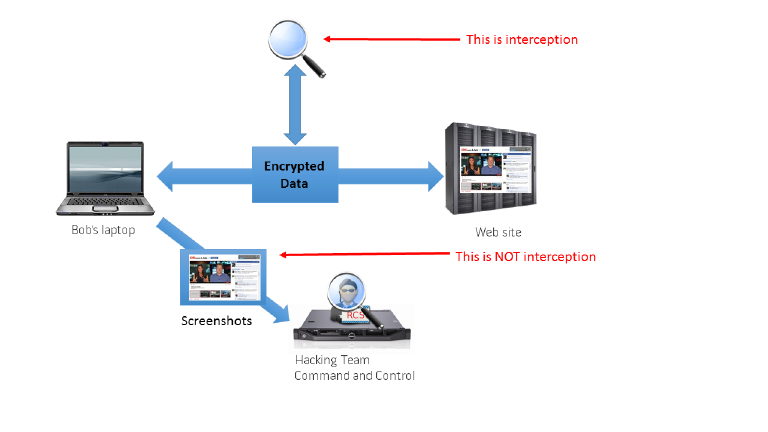
Hacking Team Interception

More worrying, is that the spyware might take screen shots of diary entries and notes that the victim never intended to communicate with anyone, or draft e-mail entries that they later delete are also captured by this spyware.  Obviously this falls into a different category than simple ‘interception’, but I’m not done yet.
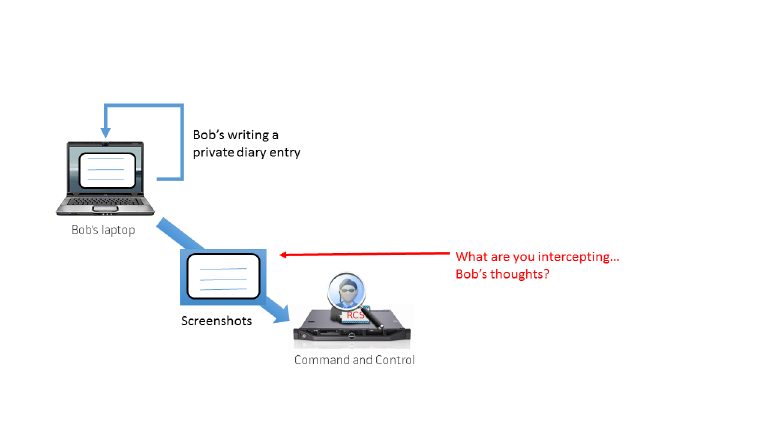
Slide2

[Read more]

The day the internet stood still–AGAIN!

There was a time when the internet was young, just a little fledgling network, an academic toy used only by computer scientist to try out theoretical concepts. Contrary to popular belief the internet wasn’t created to withstand a nuclear war(although it can), instead it was created to address a very serious engineering question–how to connect together different computers with different operating systems and different commands? The answer to that question stumped many brilliant people, in the late 60’s and early 70’s, computers were Gods of their domain, stand-alone machines with ‘slaves’ like disk-drives and monitors, if you hooked up a computer to another computer, they wouldn’t know what to do–there’s a chinese saying about one mountain can only have one dragon, computers in those days were exactly like that.

[Read more]

Why do computers like to calculate Pi?

Pi has always held a special place in my heart and probably yours as well. When people ask me to pick a number between 1 to 10, I always pick Pi (or sometimes the square root of two), which hasn’t made me the life of many parties.

And there’s an entire community of Pi lovers like me out there–people who are just fanatical about calculating pi to the trillions of digits? With just the first 40 digits of Pi we’ll be able to calculate the circumference of our galaxy with an error that is smaller than the size of a proton, so calculating PI to trillions of digits is quite superfluous. So why then do people do it?

[Read more]

WTF is a bitcoin?

WTF is BitCoin

WTF is a bitcoin? There’s much ado over the digital currency and many people struggle to understand what it is. In fact, even I haven’t fully grasped the fundamental nature of how it works–but then again I don’t know how the banking and fiat currency system work, yet I still use it.

In essence, there’s been a huge amount of really technical literature written about bitcoin, but most of it is long–really long, and unless you’re prepared to spend a few hours and some mind-numbing amount of effort to digest it, I took it upon myself to distil my knowledge of bitcoin so that you have at least a working knowledge of it.

So here’s bitcoin explained.

Don't think of it as a currency

The first mistake people make is thinking of bitcoin as a currency, the analogy works but not so well. A piece of paper currency has a valued ascribed to it by a central bank. In Malaysia, Bank Negara controls and regulates the Ringgit--and it can restrict foreign outflow (just like we did in 1997) and we can print more ringgit to pay of debt (just like what the British did with the Pound). In essence the value of the ringgit isn't 'regulated' by Bank Negara, it is controlled by Bank Negara, and they have a whole bunch of levers that they can push and pull to raise or lower the price of the Ringgit.

On the other hand we have precious commodities like Gold. Gold isn’t regulated by any one central government or bank. The value of Gold is purely a result of the supply and demand in the marketplace, and just like any other precious commodity, part of that value lies it is rarity. It’s rare, and mining it is complex business, so the supply of Gold into the market is controlled by natural consequences.

Gold is valueable because it has value–a currency is valuable because a government says so.

So the best way to think of bitcoin is to treat it as digital gold rather than digital currency.

[Read more]

Why Apple will never make a 100GB iPad Model

Transcript:

Ever wonder why iPads come in 16GB and 32GB models but now 20GB? You may have asked yourself Apple never produced a 10GB or 100GB model?

All data stored in your computer is stored in binary digits, or bits. The word binary denotes two, just like bi-lingual, bi-weekly, or bicycle.

A binary number can have a value of either 1 or 0. Just like a switch can be on or off, or a gate can be opened or closed, but since it can only have two possible values, it doesn’t really have much capacity to store much information.

[Read more]

What is an IP address

I’ve been a bit slow on the post these days, part of that is because I experienced a life-changing experience some time back, but mostly because I was experimenting with a new medium–youtube!

I’ve made 3 new youtube videos, and plan to post one every week. Unfortunately, what that means is that there’s less time to spend on the regular blog post. Hopefully by the end of the year, things will stabilize and I should be able to post a youtube video and a blog post regularly. But for now, most of my effort is going to be focused on the creating those videos.

Here's my first video:

[Read more]

What is an IP address : Part 2

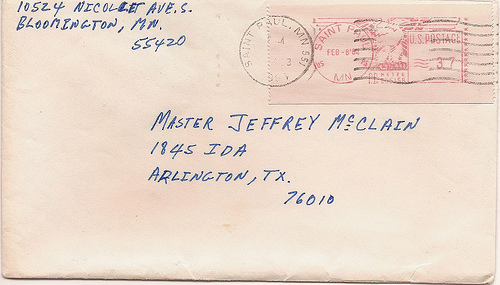
IP address on an envelope

Information flows around the internet in chunks, with chunk of data very much like a letter in an envelope. Just like how there's a special place on the back on an envelope for you to write the address of the receiver, there's a special place in every 'chunk' for you to write the address of the receiving computer. These 'chunks' of data are called IP packets, and the addresses are called IP addresses.
[Read more]

What is I.T: IP address (part 1)

What is an IP address?

IP is an abbreviation for the term Internet Protocol, and hence an IP address is an Internet Protocol address, but it’s probably easier to think of it as your internet address.

In much the same way that your postal address describes the location of your house in the ‘real-world’, an Internet address describes the location of a computer on the internet.

So take for example the address of the White House

1600 Pennsylvania Avenue NW Washington, D.C. 20500 U.S.

Ever stop to wonder how anyone from Malaysia could send a letter to President Obama by just addressing their letter to the correct address? In fact, the address of the White House is the same regardless of whether you’re sending it from Malaysia, Japan, Australia or even Timbuktu.

[Read more]