Posts for: #Security &Amp; Privacy

When bad advice comes from good people

What happens when a government agency tasked with providing cybersecurity “guidance” and “expertise” gives you advice like “avoid uploading pictures of yourself to avoid the threat of black magic”?

And then goes into damage-control claiming that it “was just a casual remark and did not represent the federal agency’s official position on the matter”,  only to follow-up with more ridiculous advice like “passwords should be changed constantly to prevent identity theft and hacking”.

Sometimes I sigh so often my wife gets worried—or annoyed, maybe both :)

First-off you know my view on black magic, and for an agency under MOSTI to make such an anti-science remark is just appalling. Secondly, from a security point of view, changing passwords regularly doesn’t help, and they cause more harm than good by encouraging users to use easy to remember passwords that they transform after every iteration. Think superman123, then superman456…etc.

In fact, research from Microsoft suggest changing your passwords regularly isn’t worth the effort, and the best one can do is use a password manager that would allow you to have passwords that are both unique and hard to remember across all online services you use.

The fact, that the head of cybersecurity Malaysia is giving advice that most people in the security community consider obsolete doesn’t exactly calms your nerves.

[Read more]

Security vs. Liberty : Sometimes it’s security and liberty

A public service announcement from our good friends at the FBI, warns that motor vehicles are increasingly vulnerable to remote exploits, which in the wake of the bad-ass research from Chris Valasek and Charlie Miller shouldn’t be shocking.

What struck me, is that the security advice the FBI is offering drivers was identical to the advice cybersecurity experts have been giving to–well just about everyone. As more of your car intertwines with software to provide things like automatic wipers, ABS and even bluetooth audio, the more it becomes susceptible to cyber attacks we traditionally associated with software on servers rather four-wheeled auto-mobiles.

[Read more]

FBI vs. Apple : Everything you need to know part 2

broken-fence

The Apple vs. FBI story has evolved so much in the past weeks, I thought I needed to write a separate post just on the updates. Admittedly, the story is far more complex and nuanced that I initially presumed, and everyone wants to be part of the conversation.

On one side, we have the silicon valley tech geeks, who seem to be unanimously in the corner of Tim Cook and Apple, while on the other  we have the Washington D.C policy makers, who are equally supportive of James Comey and the FBI whom he directs.

But to understand this issue from a fair and balanced perspective, we need to frame the correct question, not just what the issue about, but who is the  issue really focused on.

This isn't just about the FBI or Apple

Framing this as the FBI vs. Apple or The Government vs. Apple is wrong. This is Law Enforcement vs. Tech Companies.

The FBI is just a part of the The Government, specifically the part tasked with investigating federal crimes.James Comey, FBI director, is genuinely trying to do his job when he uses the All Writs Act to compel Apple to create a version of iOS that would allow them to brute-force the PIN code.

But there are other parts of The Government, like the NSA, who have the wholly different task of national security. To them, if a smartphone, is genuinely secured from FBI, then it’s secured from Russian Cybercriminals and Chinese State Sponsored actors too (probably!).

And because so much data are on smartphones, including the smartphones of federal government employees, the national security interest of America is better protected by having phones that are completely unbreakable, rather than ones the provide exceptional access to law-enforcement. Exceptional being defined as, no one has access except for law enforcement, and perhaps TSA agents, maybe border patrol and coast guard–you can see how slippery a slope ’exceptional’ can be. Oh and by the way, exceptional doesn’t exist in end-to-end encryption.

Former NSA director, Michael Hayden, has openly said “I disagree with Jim Comey. I actually think end-to-end encryption is good for America”. So it appears the NSA has an interest of national security that competes with the FBIs interest of investigating crimes.

The Government isn’t a single entity with just one interest, rather it is a collection of agencies with sometimes competing objectives, even though they all ultimately serve their citizens.  Experts believe the NSA has the capability to crack the iPhone encryption easily, but are refusing to indulge the FBI, because–well it’s hard to guess why the NSA don’t like the FBI.

testimony to House Judiciary Committee. Both methods involved complicated forensics tools, but would cost a few hundred thousand dollars (cheap!) , and wouldn’t require Apple to write a weakened version of iOS. If the goverment can get into the phone for $100,000 , that would mean it couldn’t compel Apple under the All Writs Act (AWA).

Remember, the FBI buy their spyware from the lowlifes at hacking team, which means they’re about as competent as the MACC and Malaysian PMO, but if Comey and Co. can afford $775,000 on shit from Hacking Team, I’m guessing $100,000 for a proper computer forensics expert isn’t a problem.

But maybe there’s an ulterior motive here, at the very recently concluded Brooklyn iPhone case, Magistrate Judge Orenstein noted that necessity was a pre-requisite for any request made under AWA, and if the FBI have an alternative for a reasonable price, then Apple’s support was not necessary, and hence outside the ambit of the AWA. So maybe the NSA isn’t providing the support to necessitate the NSA.

An this isn’t singularly about the FBI either. The New York A-G is waiting for this case to set precedent before he makes request for the 175 iPhones he’s hoping to unlock for cases that aren’t related to terrorism or ISIS. You can bet he’s not the only A-G waiting for the outcome, and it’s highly unlikely for the Judge to make her ruling so specific that nobody except the FBI could use it as precedent.

But it’s also not just about Apple. The legal precedent set by this case would apply not just to every other iPhone, but possibly every other smartphone, laptop, car or anything else we could squeeze into the definition of a computer. This is about more than Apple, and that’s why the tech companies are lining up in support of Mr. Cook, 32  such companies the last I checked.
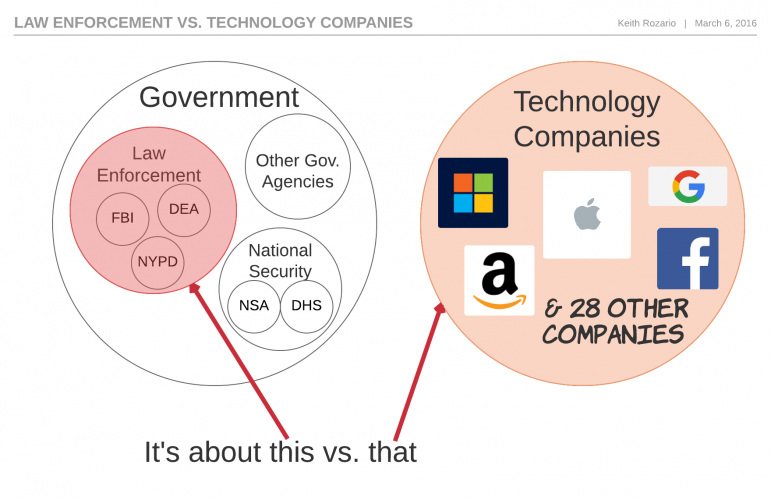
us vs. them

But now that we’ve framed the ‘who’ , let’s frame the ‘what’.

[Read more]

The miners dilemma - Bitcoin sabotage can be profitable

black dice

Imagine a small village of a 100 people.

One day,  a sorcerer shows up,  and grants all the villagers magical 1000-sided dice, which are purely random and can only be thrown at a fixed rate of 1 throw per second (no faster & no slower).

Over the next year, at noon of every day, the sorcerer will announce a random number between 1 and 1000, and the first villager to throw that number on their magical dice will earn $100, just by raising than hands and announcing it to the wizard.

The villagers play along, and the since the dice are purely random, each villager can expect to win $100 every 100 days.

But if they pooled their dice together they could create interesting scenarios. For example, a group of 10 ‘pooled’ villagers, could expect to win once every 10 days, and the winnings of $100 could be equally divided between them. To these villagers $10 every 10 days is a better deal than $100 every 100 days.

Eventually the village ends up with 2 pools of 50 villagers each. The pools expect to win once every other day, and the winnings would be $2 dollars per villager. So effectively, they’re winning $2 every 2 days.

So far so good.

The Crooked Pool attacks

crooks

However, one of these pools (called the crooked pool), starts to act all dick-dastardly. They send 25 of their members to infiltrate the other ‘honest’ pool. These infiltrators will roll their dice, but never claim announce their winnings to the sorcerer, even if they roll the magical number. Essentially these infiltrators become dead-weight on the honest pool, rolling dice choosing to never win. The remaining 25 members in the crooked pool will continue rolling and trying to win.

At first this seems illogical, why would a pool intentionally give up half it’s resources to sabotage another? How could discarding winnings actually benefit anyone? Does it even profit the crooks?

Yes it does:

  • The crooked pool now has 25 villagers rolling dice;
  • The honest pool has 75 villagers, but only 50 of them are effectively trying to win
  • Don't forget, the crooked pool has 25 members in the honest pool, and hence is entitled to 1/3rd of their winnings.
  • Which means the original 50 villagers in the honest pool, only get 2/3rd of their winnings.
  • With only 75 villagers effectively throwing the dice, the crooked pool now has both it's original 25 members and a 1/3rd share of the remaining 50.
  • The maths is only a 'bit' complicated, but the result is the crooked pool increases its chances of winning from 50% to 56%.
Amazing right?! Even though the 25 infiltrators are essentially wasting their throws, they can actually profit from the activity.

This isn’t just a thought experiment either, this is a problem known in bitcoin as the miners delimma, analogous to famous prisoner dilemma thought in game theory. Bitcoin mining works almost exactly like this scenario, it is a purely random function similar to dice throwing, whose odds of success can only be increased if you ramp up the hashing power, or in this case, adding villagers to a pool.

[Read more]

Apple vs. FBI: Everything you need to know

broken-fence

A judge in the US has ordered Apple to provide ’technical assistance’ to FBI, in creating what some (but not all) cybersecurity experts call a backdoor. In the few years I’ve written about these issues, I’ve never seen anything as hotly debated as this one, across the folks from digital security to foreign policy all coming down on both sides of the debate.

On one hand it seems a bit snarky of the FBI to use this one particular case, that looks to have the highest possible chance of success to set precedent, but on the other hand it seems mighty nasty of Apple to refuse to comply with a court order, to crack into a terrorist phone.

So here’s some facts of the case.

The phone in question belonged to Syed Rizwan Farook, a shooter in the San Bernadino shooting, which caused the deaths of 14 people. America has numerous mass shootings, but this one involved two Muslims aligned to ISIS–and hence more easily labeled terrorism, without the need for adjectives like ‘domestic’.

As I blogged about last week, self-radicalized terrorist don’t get funding from headquarters, and without that glorious ISIS-oil money, all these guys could afford for was an iPhone 5C, an entry-level phone with hardware identical to that of the iPhone 5, a phone launched waaaayy back in 2012 (you’ll remember that as the year Manchester United last won the Premier League). As an older phone, the security architecture of the 5C lagged behind the current generation iPhones, all of which have a secure enclave, but make no mistake, it’s still pretty secure.

By pretty secure, I mean that the phone has all of its contents encrypted, and un-readable to anyone without the encryption key. The key is derived from both the user passcode, and a randomly generated hardware key that is unique to the specific iPhone. It is generally understood that Apple doesn’t keep track of the hardware key, and therefore unable to provide it, as you might expect the hardware will also never give up it’s key under any circumstance. Without the hardware key, the encrypted  data is unreadable, even with the passcode. Which explains why the FBI can’t suck the data out of the device for decryption on a more powerful computer, or load the data into 1000’s of iPhones for parallel cracking.

[Read more]

Keith’s on BFM Talking about spyware–again!!

Keith_on_BFM_Tech_Talk

Today, I was on BFM talking about Hacking Team, the audio for which is below, and more comments and thoughts below that.

This is my last ditch attempt to get a conversation started about the use of surveillance software by the Government—and these conversations should take place a the higher (and more powerful) levels of goverment. Talking about it to myself on this blog isn’t taking it anywhere.

[Read more]

Forcing journalist to reveal sources will be bad–for the government!

Our spanking new, hand-picked Attorney-General is proposing life imprisonment for journalist who refuse to reveal their sources.

And surprisingly, my favorite Member of Parliament,Dato Azalina Othman, has supported the move, saying it was ‘high-time’ Malaysian did something. Fortunately, some calmer more rationale heads, like Dato Paul Low have criticized the A-G for his short-sighted stupidity.

Putting aside the fact that anonymity of sources is a core component of Press freedom, it’s easy to extrapolate how harsher punishment for journalists who keep their sources anonymous will back-fire spectacularly for the Government.

If sources know that Journalist will be pressured to reveal their identities, most sources will stop speaking journalist, thereby stemming the leakages from the government, and keeping the status quo.Or so the theory goes…

[Read more]

Being Terrified: The price of terrorism

Next week, I’ll be on BFM for an interview about spyware, which will be my last Hail Mary play to get a conversation started about the use of surveillance software by the Government. If a radio interview on a popular station won’t do it, nothing on my blog will possibly be able to anyway :)

In any case, this post is a pre-emptive response to a slightly controversial idea that I cover (very briefly) in the interview, and hopefully it can be articulated better here than in a radio segment. To be honest, I haven’t fully thought this through, but I believe it at least some some aspects of truth that deserve further attention.

The Idea comes in 3 parts:

  1. Terrorism has changed dramatically with ISIS (or Daesh)
  2. Our conventional approach to surveillance will be ineffective against this new threat
  3. Our surveillance-based response to the new threat may end up hurting us more than ISIS ever could
Let's go through them one at a time
[Read more]

Questions we need to ask about spyware

If you believe (as I do), that the government bought spyware, then here are some pertinent questions

Question 1: Do these government agencies actually have investigative powers?

While the police might have the legal authority to investigate someone, does the PMO, MACC or anyone else share that authority. If a government agency has no right to investigate someone, then why is it buying spyware?

The conversation should end here, as I don’t believe the PMO has any authority to use spyware, but the next question actually goes even further and ask if anyone has the legal authority to use it.

Question 2: Is spyware legal?

Installing spyware on a laptop or smartphone is far more intrusive than a regular home search, it's like having an invisible officer stationed in your house listening in on everything you say and do. It doesn't just invade the privacy of the victim, but even those that victim communicates with, shares their laptop with or even those that just happen to be nearby.

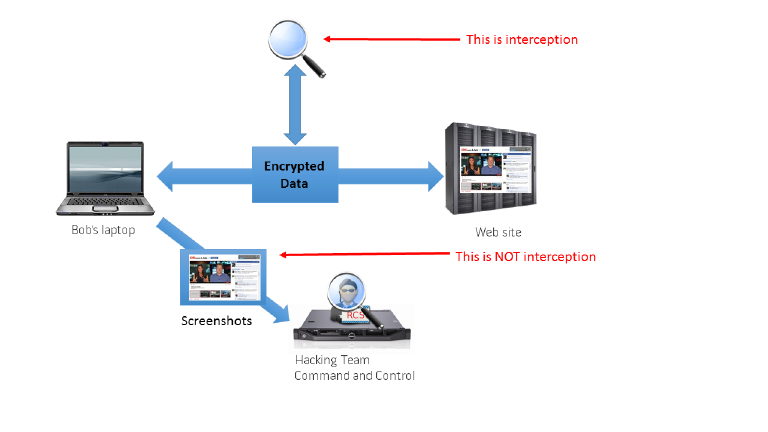
The MACC act, that governs the powers of the commission, specifically state that a the Public Prosecutor or Commissioner of the MACC can authorize the interception of communications if they ‘consider’ that the specific communication might help in an ongoing investigation. However, spyware from hacking team isn’t really ‘intercepting’ communications, because what is being communicated through the Internet is usually encrypted, Hacking team circumvents this by capturing the data before it is encrypted and then sends that captured data in a separate communication back to its control servers. Strictly speaking, this isn’t interception, its shoulder surfing on steroids.

Hacking Team Interception

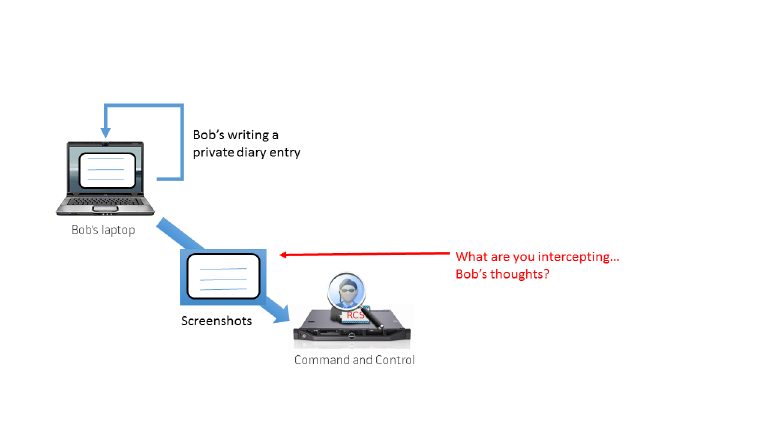
More worrying, is that the spyware might take screen shots of diary entries and notes that the victim never intended to communicate with anyone, or draft e-mail entries that they later delete are also captured by this spyware.  Obviously this falls into a different category than simple ‘interception’, but I’m not done yet.

Slide2

[Read more]

PMO purchases of Hacking Team software

[caption id=“attachment_5373” align=“aligncenter” width=“550”]

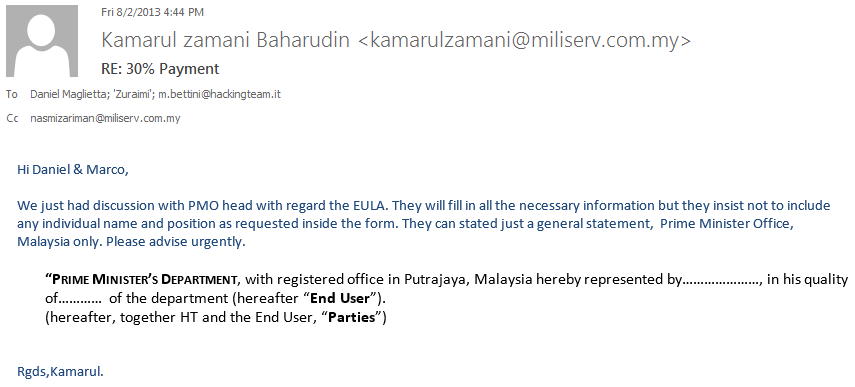
E-mail from Miliserv to Hacking team stipulating the end-customer as the Prime Ministers Department

E-mail from Miliserv to Hacking team stipulating the end-customer as the Prime Ministers Department[/caption]

The Prime Ministers Department has denied (twice!) that it has ever procured surveillance software from Hacking Team. Even though hundreds of e-mails in the leaked Hacking Team archive point to it. The latest rebuttal, Datuk Azalina distanced her Ministry from other government agencies, encouraging reporters to seek official statement directly from other agencies accused of procuring the spyware.

In the mean-time though, we’ve now learnt that the MACC has made a ‘semi’ admission that they procured the spyware, and to clear any doubts there’s more proof at the end of this post. But in-spite of this, Datuk Seri Azalina has remained silent.

To be clear, I’m not accusing anyone of anything. I’m merely reproducing what is already in the public domain, in the hopes of us taking this conversation further to address more pertinent points. We are frustratingly stuck on this issue of purchase (or lack thereof) because the Prime Ministers Department denies it bought spyware. I find it quite appalling that the Ministry would issue a simple denial without further clarification when I had furnished many documents, in other words they’ve provided an unsubstantiated denial to my substantiated claim.

So…here’s an e-mail (linked here), showing Miliserv requesting Hacking Team to register the Prime Ministers Department as the End User of the system in the Licensing agreement, and here’s another (below), showing Miliserv preparing to welcome 6 PMO staff to their headquarters in Milan for ‘advanced training’. I have removed the names of the PMO staff (red blocks) as I believe that employees shouldn’t be punished for mistakes their employers commit (but you can search for it online, it comes with passport numbers as well). Why send 6 staff to Milan for training if you didn’t buy the spyware?

[Read more]