Posts for: #Security &Amp; Privacy

Access Keys in AWS Lambda

Let's look at AWS Access Keys inside a Lambda function, from how they are populated into the function's execution context, how long they last, how to exfiltrate them out and use them, and how we might detect an compromised access keys.

But before that, let's go through some basics. Lambda functions run on Firecracker, a microVM technology developed by Amazon. MicroVMs are like docker containers, but provide VM level isolation between instances. But because we're not going to cover container breakouts here, for the purpose of this post we'll use the term container to refer to these microVMs.

Anyway...

Lambda constantly spins up containers to respond to events, such as http calls via API Gateway, a file landing in an S3 bucket, or even an invoke command executed from your aws-cli.

These containers interact with AWS services in the same exact way as any code in EC2, Fargate or even your local machine -- i.e. they use a version of the AWS SDK (e.g. boto3) and authenticate with IAM access keys. There isn't any magic here, it's just with serverless we can remain blissfully ignorant of the underlying mechanism.

But occasionally it's a good idea to dig deep and try to understand what goes on under the hood, and that's what this post seeks to do.

So where in the container are the access keys stored? Well, we know that AWS SDKs reference credentials in 3 places:

  • Environment Variables
  • The ~/.aws/credentials file
  • The Instance Metadata Service (IMDS)

If we check, we'll find that our IAM access keys for lambda functions are stored in the environment variables of the execution context, namely:

  • AWS_ACCESS_KEY_ID
  • AWS_SECRET_ACCESS_KEY
  • AWS_SESSION_TOKEN

You can easily verify this, by printing out those environment variables in your runtime (e.g. $AWS_ACCESS_KEY_ID) and see for yourself.

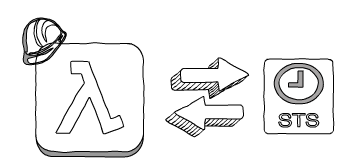
OK, now we know where the access stored keys are stored, but how did they end up here and what kind of access keys are they? For that, we need to look at the life-cycle of a Lambda function...

[]

Contact Tracing Apps: they’re OK.

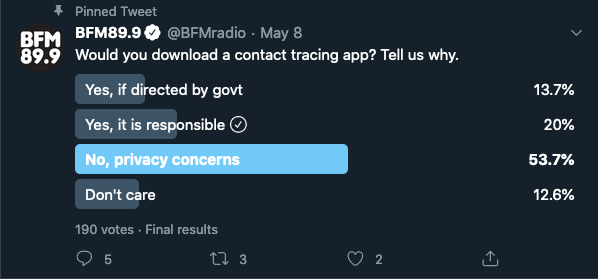
I thought I'd write down my thoughts on contact tracing apps, especially since a recent BFM suggested 53% of Malaysians wouldn't download a contact tracing app due to privacy concerns. It's important for us to address this, as I firmly believe, that contact tracing is an important weapon in our arsenal against COVID-19, and having 54% of Malaysians dismiss outright is concerning.

But first, let's understand what Privacy is.

Privacy is Contextual

Privacy isn't secrecy. Secrecy is not telling anyone, but privacy is about having control over who you tell and in what context.

For example, if you met someone for the first time, at a friends birthday party, it would be completely rude and unacceptable to ask questions like:

  • What's your weight?
  • What's your last drawn salary?
  • What's your age?

In that context you're unlikely to find someone who will answer these questions truthfully.

But...

Age and weight, are perfectly acceptable questions for a Doctor to ask you at a medical appointment, and your last drawn salary is something any company looking to hire you will ask. We've come to accept these questions as OK -- under these contexts.

You might still not want to answer them, which might mean you don't get the job, or the best healthcare -- but you certainly can't be concerned by them. Far more people will answer these same questions truthfully if you change the context from random stranger at a party to doctors appointment.

So privacy is contextual, to justify concerns we have to evaluate both the context and the question before coming to a conclusion.

So let's look at both, starting with the context:

[]

My experience with AWS Certified Security - Specialty

Last week I took the AWS Certified Security - Specialty exam -- and I passed with a score of 930 (Woohoo!!)

In this post I cover why I took it, what I did to pass, my overall exam experience, and some tips I learnt along the way.

So let's go.

Why?

Why would anybody pay good money, subject themselves to hours of studying, only to end up sitting in a cold exam room for hours answering many multiple choice questions!

And the reward for that work is an unsigned PDF file claiming you're 'certified', and 'privilege' access to buy AWS branded notebooks and water bottles!! Unless those water bottles come with a reserved instance for Microsoft SQL server in Bahrain, I'm not interested.

But, jokes asides, I did this for fun and profit, and fortunately I really did enjoy the preparing for this exam. It exposed me to AWS services that I barely knew -- and forced me to level-up my skills even on those that I knew.

The exam has a massive focus on VPC, KMS, IAM, S3, EC2, Cloudtrail and Cloudwatch. While lightly touching Guardduty, Macie, Config, Inspector, Lambda, Cloudfront, WAF, System Manager and AWS Shield.

You need to catch you breath just reading through that list!

But for those diligently keeping count -- you'd notice that the majority of those services are serverless -- meaning the exam combined my two technological love-affairs ... security and serverless!

I wasn't lying when I said it was fun. So what about the profit.

I'm not sure how good this would be for my career (I literally got the cert last week), but for $300, it's is relatively cheap, with a tonne of practical value. So trying to get an ROI on this, isn't going to be hard.

For comparison, the CCSP certification cost nearly twice as much, is highly theoretical and requires professional experience.

The results also help me validate my past years of working on serverless projects, proving I wasn't just some rando posting useless hobby projects on GitHub. Instead, I'm now a certified AWS professional, posting useless hobby projects on GitHub (it's all about how you market it!)

So now that we've covered the why, let's move onto how.

[]

Run serverless on GitHub actions

GitHub actions is the new kid on the workflow block.

It allows users to orchestrate workflows using familiar git commands like push & pull requests, and un-familiar GitHub events like gollum, issue creation and milestone closures.

In this post, we'll use GitHub actions to orchestrate a build pipeline that will deploy lambda functions using the Serverless framework. There's a lot of tutorials that cover the basics of doing this, but we'll dive deeper and cover off framework plugins and deploying to different environments using feature branches.

[]

Lambda functions in a VPC

In my honest (and truly humble) opinion, VPCs don't make much sense in a serverless architecture -- it's not that they don't add value, it's that the value the add isn't worth the complexity you incur.

After all, you can't log into a lambda function, there are no inward connections allowed. And it isn't a persistent environment, some functions may timeout after just 2-3 seconds. Sure, network level security is still worthy pursuit, but for serverless, tightly managing IAM roles and looking after your software supply chain for vulnerabilities would be better value for your money.

But if you've got a fleet of EC2s already deployed in a VPC, and your Lambda function needs access them. Then you have no choice but to deploy that function in a VPC as well. Or, if your org requires full network logging of all your workloads, then you'll also need VPC (and their flow logs) to comply with such requests.

Don't get me wrong, there is value in having your functions in a VPC, just probably not as much as you think.

Put that aside though, let's dive into the wonderful world of Lambda functions and VPCs

Working Example

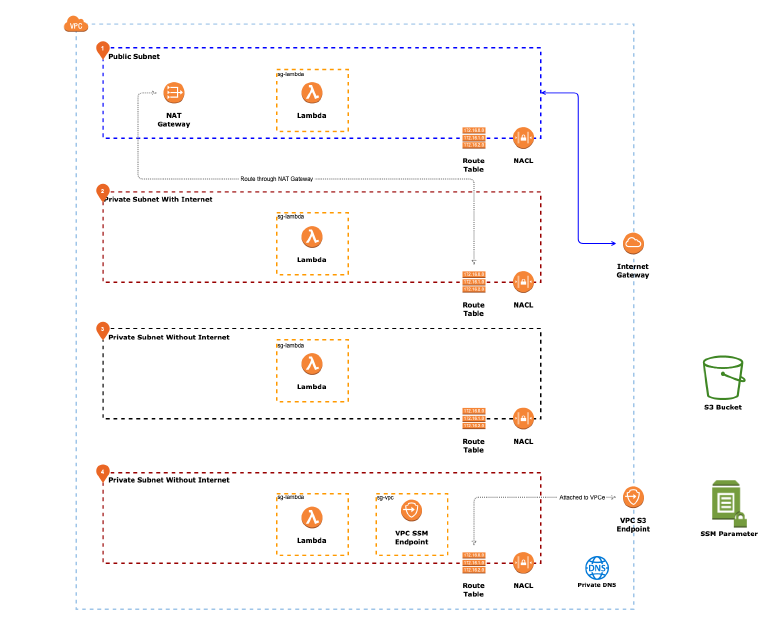
First, imagine we deploy a simple VPC with 4 subnets.

  1. A Public Subnet with a Nat Gateway inside it.
  2. A Private Subnet which routes all traffic through that NAT Gateway
  3. A Private Subnet without internet (only local routing)
  4. A Private Subnet without internet but with a SSM VPCe inside it

Let's label these subnets (1), (2) ,(3) and (4) for simplicity.

Now we write some Lambda functions, and deploy each of them to each subnet. The functions have an attached security group that allows all outgoing connections, and similarly each subnet has very liberal NACLs that allow incoming and outgoing connections.

Then we create a gateway S3 VPC-endpoint (VPCe), and route subnet (4) to it.

Finally, we enable private DNS on the entire VPC. And then outside the subnet we create a bucket and an System Manager Parameter Store Parameter (AWS really need better terms for these things).

The final network looks like this:

[]

Amazon KMS: Intro

Amazon KMS is one of the most integrated AWS services, but probably also the least understood. Most developers know about it, and what it can do, but never really fully realize the potential of the service. So here's a rundown of the innards of the KMS service.

What is KMS?

KMS (Key Management Service) is an AWS offering that allows us to create, manage and use cryptographic keys. Like everything else in AWS, it's highly available, provided via API, and charged on a per-use basis.

[]

Interactive Shell on a Lambda Function

One of a great things about Lambda functions is that you can't SSH into it.

This sounds like a drawback, but actually it's a great security benefit -- you can't hack what you can't access. Although it's rare to see SSH used as an entry path for attackers these days, it's not uncommon to see organizations lose SSH keys every once in a while. So cutting down SSH access does limit the attack surface of the lambda -- plus the fact, that the lambda doesn't exist on a 24/7 server helps reduce that even further.

Your support engineers might still want to log onto a **server**, but in todays serverless paradigm, this is unnecessary. After all, logs no longer exists in /var/logs they're on cloudwatch, and there is no need to change passwords or purge files because the lambdas recycle themselves after a while anyway. Leave those lambda functions alone will ya!

As a developer, you might want to see what is **in** the lambda function itself -- like what binaries are available (and their versions), or what libraries and environment variables are set. For this, it's far more effective to just log onto a lambci docker container -- Amazon work very closely with lambci to ensure their container matches what's available in a Lambda environment. Just run any of the following

  • docker run -ti lambci/lambda:build-python3.7 bash
  • docker run -ti lambci/lambda:build-python3.6 bash

Lambci provide a corresponding docker container for all AWS runtimes, they even provide a build image for each runtime, that comes prepackaged with tools like bash, gcc-c++, git and zip. This is the best way to explore a lambda function in interactive mode, and build lambda layers on.

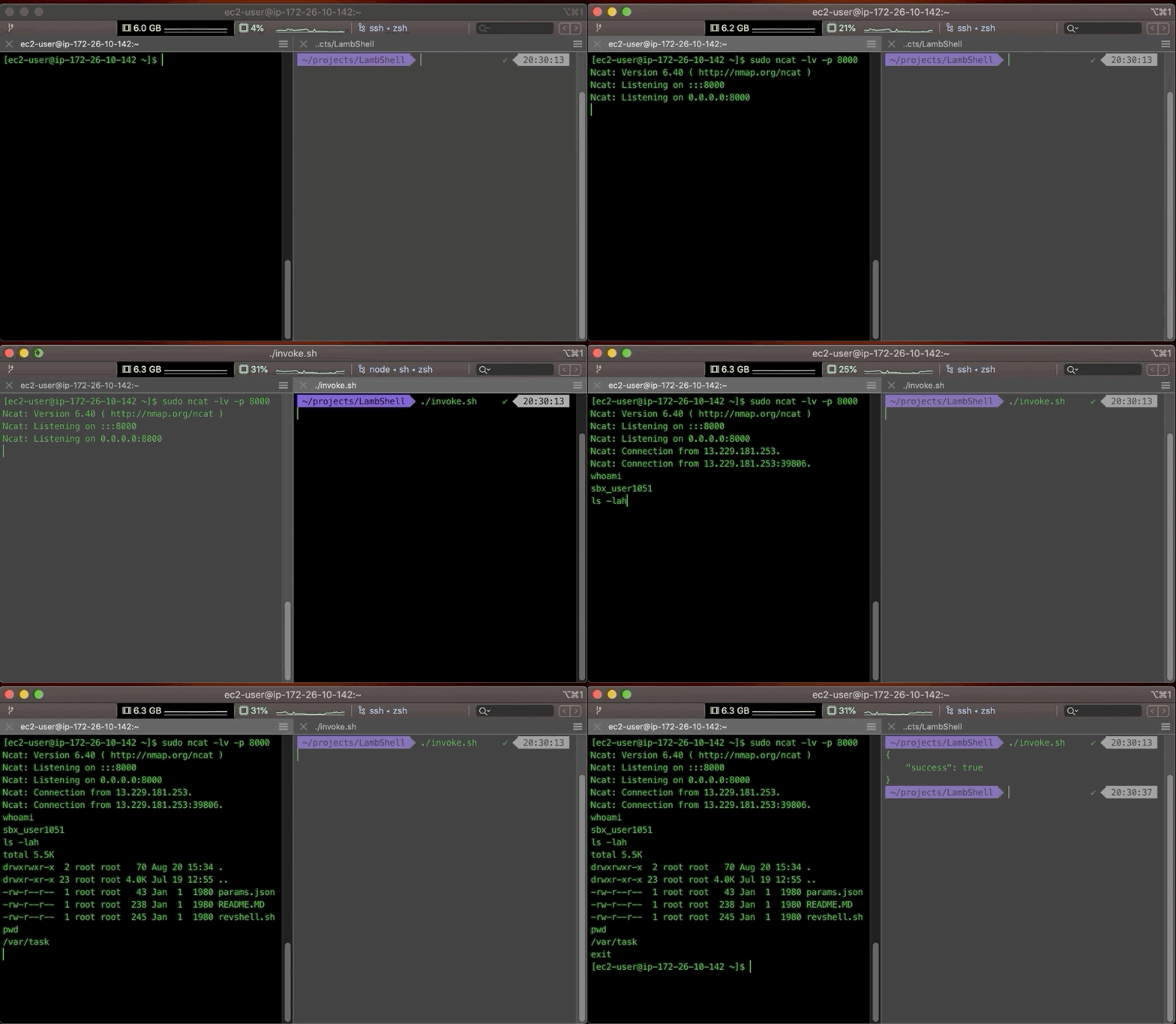
But sometimes you'll find yourself wanting to explore the actual lambda function you ran, like checking if the binary in the lambda layer was packaged correctly, or just seeing if a file was correctly downloaded into /tmp-- local deploy has it's limits, and that's what this post is for.

[]

You own your software supply chain

Just this week, my team was on the cusp of demo-ing a product they've been working on for the last 2 months, only for a build process to fail, just hours before the demo to some very high ranking people.

Troubleshooting the build took a while, but eventually we found the root cause, a missing package version! This probably wouldn't have been a big deal, had we not stumbled across it at midnight the day before an important demo -- but nevertheless failing builds are never a good thing!

[]

Securing Lambda Functions

First a definition.

A lambda function is a service provided by aws that runs code for you without the introducing the complexity of provisioning servers of managing Operating Systems. It belongs in a category of architectures called serverless architectures.

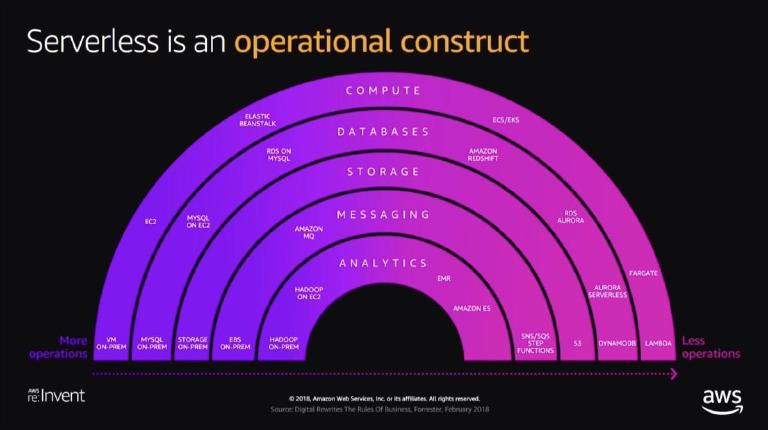
There's a whole slew of folks trying to define with is serverless, but my favorite definition is this.

Serverless means No Server Ops

Joe Emison

They're the final frontier of compute, where the idea is that developers just write code, while allowing AWS (or Google/MSFT) to take care of everything else. This includes H/W management, OS Patching, even application level maintenance like Webserver upgrades are not your problem anymore with serverless.

Nothing runs on fairy-dust though, serverless still has servers -- but in this world those servers, their operating systems, and the underlying runtime (e.g. Python, Node, JVM) are fully managed services that you pay per use.

As a developer you write some code into a function. Upload that function to AWS -- and now you can invoke this function over and over again without worrying about servers, operating systems or run-time.

But how does AWS achieve this?

Before we can understand how to secure a serverless function, we need to at least have a fair understanding of how Serverless functions (like AWS Lambda) work.

So how does a lambda function work?

[]

Thoughts on SingHealth Data Breach

On the 20th of July, Singaporean authorities announced a data breach affecting SingHealth, the country largest healthcare group. The breach impacted 1.5 million people who had used SingHealth services over the last 3 years.

Oh boy, another data breach with 1.5 million records … yawn.

But Singapore has less than 6 million people, so it’s a BIG deal to this island I currently call home. Here’s what happened.

The lowdown

According to the official Ministry announcement administrators discovered 'unusual' activity on one of their databases on 4-Jul, investigations confirmed the data breach a week later, and public announcement was made 10 days after confirmation.
4-Jul : IHiS’ database administrators detected unusual activity on one of SingHealth’s IT databases 10-Jul : Investigations confirmed the data breach, and all relevant authorities were informed 12-Jul : A Police Report is made 20-Jul : A public announcement is made
The official report states that "data was exfiltrated from 27 June 2018 to 4 July 2018...no further illegal exfiltration has been detected".

The point of entry was ascertained to be “that the cyber attackers accessed the SingHealth IT system through an initial breach on a particular front-end workstation. They subsequently managed to obtain privileged account credentials to gain privileged access to the database”

And finally that “SingHealth will be progressively contacting all patients…to notify them if their data had been illegally exfiltrated. All the patients, whether or not their data were compromised, will receive an SMS notification over the next five days”

[]