Posts for: #Science

Why the Angkasawan Program failed

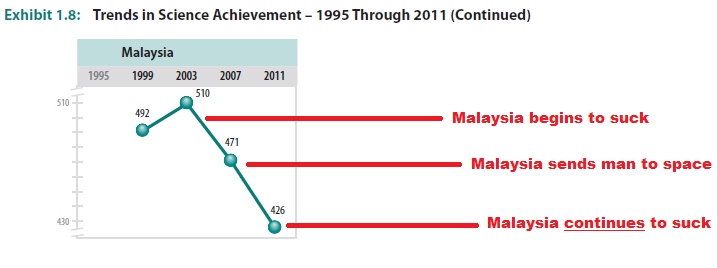
In 2003 the average score of Malaysian students in in the Trends in International Maths and Science Study 510 (slightly above the global average). In 2007, that number slumped to 471, below the global average. Then in Oct 2007, we sent a man to space. With the idea that it would "instill the interest of young Malaysians to explore new areas of science and technology " Surely our science scores would sky-rocket after such an endeavour.

It didn’t. We scored a embarassing 426 In just 8 years we went from being above average to bottom third, and the angkasawan program did absolutely nothing to arrest this slide.

Of course, the Good Minister will tell you that we’ve had 24 academic papers published as a result of the program, first of all I couldn’t find the mysteriously ‘well-received’ papers on any google searches I performed. Including papers related to the Food In Space experiment, which was meant to taste 9 difference Malaysian delicacies on board the ISS. Notice also, that the word collaboration is wrongly spelt on this slide.

[Read more]

Why Malaysia should never send anyone into space again–EVER!!

Angkasawan_on_science

There's been a lot of talk lately on Malaysia sending a second Angkasawan into space. Unfortunately, we don't seem to be getting our moneys worth, the Angkasawan program has done nothing to stop the slide in our Scientific literacy in Malaysia, in fact, if the graph above is anything to go by it's actually made the it worse.

One of the key reasons always cited to support the Angkasawan program is to promote the understanding of science and maths in Malaysia–unfortunately, the Angkasawan program seems to have a negative effect on our international test scores for science. I wonder why? I’ve made a video on why the angkasawan project was a waste of time, check it out here.

[Read more]

STEM in Malaysia

Taken from the newly minted Education Blueprint:

Malaysia places great importance on education as a means of becoming a developed nation to meet the challenges and demands of a STEM driven economy, by 2020. Accordingly, the Malaysian government instituted the 60:40 Science/Technical: Arts (60:40) Policy in education in 1967 and started implementing it in 1970. The policy refers to the Ministry’s target for the ratio of students with significant STEM education to those with a greater focus on the Arts. This policy target has, however, never been met due to various factors discussed below.

In 2011, only 45% of students graduated were from the Science stream, including technical and vocational programmes. Additionally, the percentage of secondary school students who met the requirement to study Science after PMR but chose not to do so increased to approximately 15%. This raises concerns about the education system’s ability to produce sufficient STEM graduates for the economy.

[Read more]

Journalist mixes capital ‘M’ and little ’m’, makes Sabah most energy efficient state by a mile

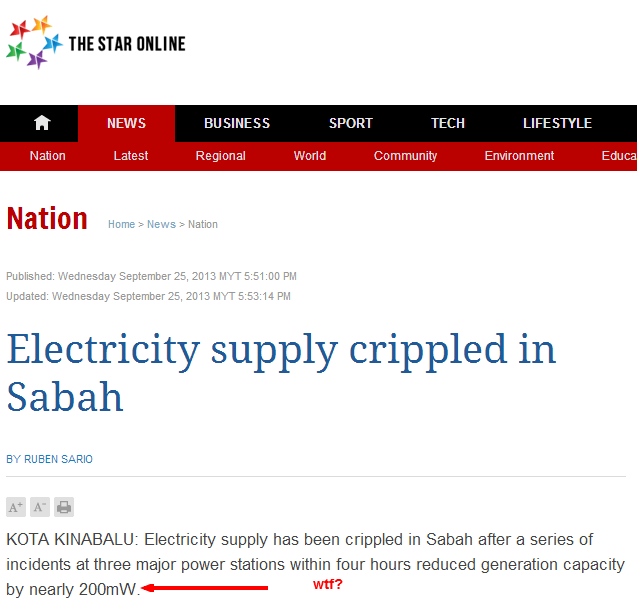
Electricity supply crippled in Sabah   Nation   The Star Online

The Star today reported that the entire state of Sabah had its electricity supply 'crippled'. I used inverted commas because the article goes on to say that the reduction was as much as 200mW.

Now, any school child in a reasonably good school is going to tell you 200mW is nothing. 200mW actually translates to just 200 milli-watts, or 0.2 Watts. That’s less than 1 Watt!!

You see in science (and more specifically engineering), the lower-case  ’m’ is used to denote the prefix ‘milli’ or 1/1000th. It’s why a millimetre is 1000 times shorter than metre, and why a milligram is 1000 times less mass than a gram.

I would have dismissed this as a typo, if the article didn’t continue to read:

[Read more]

Ibrahim Ali gets his maths wrong

ibrahimali_calculator_rosak

There’s something terribly wrong, when a politician can’t get his million, billions and trillions correct. This Malaysian Insider story has quoted my favorite bigot as saying:

[box icon=“chat”]

“Right now, the GNI of Bumiputeras is RM56 million. So to achieve RM900 billion by 2020, the government must provide funds worth RM1.4 trillion to Bumiputeras,” he said.

I’m pretty sure the 56 million is a typo or just a slip of the tongue, however the RM900 Billion requiring Rm1.4 Trillion, is some what of a ‘calculator rosak’ moment for Ibrahim Ali. Of course this begs the question—where will the additional RM500 Billion go?

[Read more]

Of pirated software and vaccinations

4699834026_5d07d3ea19

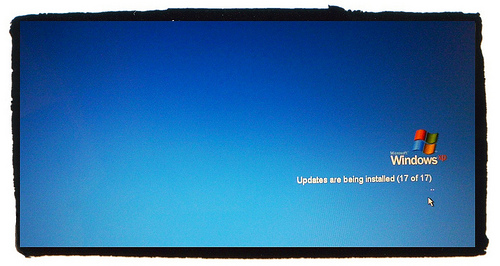
Here’s a quick question–do you have a ‘original’ version of Windows running on your PC or is it pirated?

If you’re like me, then obviously you’ve learnt long ago to only use original versions of software–especially when it’s the operating system of your PC. Of course, I wasn’t always like this, back in my university days, I couldn’t afford the couple hundred dollars it cost to buy an original Windows XP, and hence used a pirated version–my windows installation CD was actually burnt from a pirated CD, I wonder if that made me a pirate of a pirate?

One of the things that puzzled me was that even with my obviously pirated software, I could still download Windows software security updates–something I thought represented Microsofts failure to engineer a way to check on the legitimacy of my software. It wasn’t until much later, that I discovered the true reason for Microsoft seeming benevolence–Microsoft was merely protecting it’s paid customers by providing free updates to the pirates.

Say what now?

It may sound ironic, but one of the best ways for Microsoft to provide security for their paying customer is to ensure that even the pirates receive security patches.

Imagine for a moment if Microsoft didn’t allow patching for pirated Windows, and assume that 20% of the Windows machines on the internet were pirated. What that would mean is that 20% of all PCs on the internet would be vulnerable to each and every Windows vulnerability discovered. That’s a large chunk of customers that would be affected, and the real down-side is that the 20% of pirated customers could end up re-infecting legitimate paying Windows customers. So in order to reduce the spread of vulnerabilities in it’s ecosystem, Microsoft had to protect it’s paying customers, by patching its pirated copies.

Vulnerabilities aren’t fun for Microsoft, but they’re a fact of life–and being the dominant Operating System of the 1990’s and 2000’s meant the Microsoft received more than it’s fair share of attacks, the problem of course was how to address the vulnerabilities as and when they’re discovered?

There are two ways to deal with this problem: Limit the number of people who know about the attack or reduce the number of systems that are vulnerable. The first method has been tried for years with little success. This leaves us with the option of reducing the number of vulnerable machines on the Internet. Or as one team of researchers noted (pdf), “a vulnerability dies when the number of systems it can exploit shrinks to insignificance."[1]

So Microsoft followed the science and attempts to shrink the number of vulnerable systems to insignificance, and that can only mean allowing patches for pirated versions of Windows, no two ways about it, a world where Microsoft didn’t allow pirated version of Windows to be patched would be a dangerous world to live in.
[Read more]

The Star pisses me off–again.

I pity TheStar, it gets whacked from both sides of the political spectrum, one for being too pro-government, and for not being pro-government enough. However, my sympathy has its limits when I saw what is undoubtedly the single stupidest article in any newspaper titled “Spicy food can trigger aggression

Now sure, the wonderful world of science sometimes throws us a surprise every now and then, but to link spicy food to aggression without any form of scientific study is tasteless (in every sense of the word). Not only can it reinforce bias on cultures that love their spicy food (Thais and Indians), it also serves to mis-inform the public by passing off what is one mans opinion as scientific fact–when it truly isn’t.

[Read more]

Illegal numbers?

Great video from the guys at Numberphile talking about illegal numbers. It always amazes to think that your money in the bank isn't protected by steel doors or guards with guns anymore--it's protected by numbers. (more specifically it's protected by one VERY VERY large number).

The encryption key that is responsible for keeping your sensitive bank details secret, is nothing more than a very very long number, and that number protects your money more than any steel door or armed guard ever could.

[Read more]

Why is Malaysia trailing Singapore, Taiwan, Korea

[gallery orderby=“post_date”]

A lot of people ask why Malaysian has fallen behind countries like Korea, Taiwan or Singapore in terms of our economic development. The answer most politicians give is corruption–but there’s hardly any data to suggest that’s a big issue–at most corruption can account for the ’loss of income’. There’s no guarantee that the money we saved by eliminating corruption would be spent wisely on good projects, there’s no guarantee we’d be where Korea, Taiwan or Singapore is even if we had no corruption. Do you think there’s corruption in Kelantan, yet they seem to be trailing behind everyone in terms of development? Low corruption is not a guarantee of good education.

[Read more]