Posts for: #Keith's Favorite Post

Can you out-tech the government?

Over the past years we’ve seen a recurrent theme where Government agencies were attempting to curtail internet freedom in the name of ‘keeping the peace’. From Saudi telcos threatening security experts to help them hijack tweets to governments procuring tools like Finspy to spy on their citizens–usually without any warrant or legal oversight. We’ve seen US federal agencies try to legislate mandatory technical backdoors into software and how the Syrian government treats internet access for its Citizens like candy for their children–you only get it if you behave.

In Pakistan, a wholesale blockade of youtube means their citizens are missing not just Gangnam Style, but Gentlemen as well (although that may not necessarily be a bad thing)–and we all know how much censorship and surveillance is going on in China.

A French court is now asking twitter to hand over account details to identify individual users that tweeted anti-semitic messages, both the Dutch and German police are users of spyware from companies that the are deemed ‘corporate enemies of the internet’ by reporters without borders, and while you may agree that courts have a right to curtail hate speech, just ruminate for a moment how one-sided French law is when they aggressively pursue anti-Semitic messages  but forbid Muslims school girls from wearing a hijab to school because it is supposedly a symbol of oppression. These biases point to deep flaws in our belief that freedom of speech can somehow be regulated by governments–the term regulated freedom of speech is an oxymoron to begin with.

This of course doesn’t just affect the ‘bad’  countries, those with lifetime membership cards to the axis of evil, but countries we’d generally consider good guys as well, those we associate with a respect for personal privacy and citizen rights, so that we did end up like this? To truly appreciate where we are we need to go back to how it all starts.

A false sense of Insecurity

Throughout history it all starts in the name of national security, or keeping the peace. Government agencies ramp up the security concerns and threat levels to grant a false sense of insecurity to its citizens--because it's only in this environment that citizens are willing to grant such unilateral powers to the government (and its agencies). People aren't too willing to allow for unilateral government interception of communications--unless of course they perceive that terrorist live among us, and the government requires these powers to protect the innocent.

The track records of governments has never been good. September 11 was a colossal failure of government intelligence, and it’s usually used an example of why governments should do better. What most people don’t know is that a company called Acxiom had data for 11 hijackers, and provided that data to assist in investigations post 9/11, it turns out had the government agencies used Acxiom, they may have had additional security on the planes that crashed into the WTC. The breadth and depth of the information provided to law enforcement has been kept secret–and in the wake of such attacks nobody bothered to ask whether Acxiom was operating within legal limits of collecting and storing that data–worse still people forget that Acxiom itself was hacked leaking private information of millions of Americans. Yes it may have help thwart the attacks on 9/11, but the Acxiom itself became a target of attack shortly after details of its information bounty were published, there are a lot of people who would pay for that kind of information.

Even with the fundamental problems of the government storing such private information–government agencies throughout the world continue to ramp up security concerns in the hope of scaring people into giving up their freedoms. Closer to home we continuously see the ’threat of sedition’ being used to deny individuals and private citizens their rights. The ‘possibility’ of a repeat of May 13th, is now accepted as a ‘high probability’ even though there is no data to suggest that a repeat is possible let alone probable. Just like courts in France we see a glaring bias in the execution of these sedition laws–and the targets are often pro-opposition rather than pro-government.

The Malaysian government is now being accused of running spyware suites like Finfisher, which incorporates a voyeuristic like ability on the malware owner to spy on the victims. The makers of Finfisher claim their software is only sold to governments–without realizing it’s the governments themselves that are illegally spying on its citizens.

Not since Tom Sawyer tricked his friends to paint his white fence has such levels of deception been seen.

However, the level of deception isn’t what is troubling, it’s the level of apathy among the mainstream society to these revelations that send shivers down my spine. No one from the general public seems perturbed that the very technology that was supposed to advance democracy and free speech in Malaysia is now being used to suppress it.

And we’re not the only ones spying on our citizens…

[Read more]

I’m Sorry, the Malaysian Government IS spying on you

Big Brother is watching

A couple of weeks ago, I wrote about an ‘irresponsible’ piece of journalism by the Malaysian Insider when the ‘claimed’ the Malaysian government was spying on Malaysian citizens–but they didn’t have any proof. I was very upset that a reporter would make such a bold statement and not back it up with any proof –so obviously the post was written in a caustic  and emotionally charged way–I was upset, annoyed, angry even!

More importantly though–I was wrong!

On Labour day, Citizenlab released a second report detailing out more info from they’re Finspy research.

I’ll let speak for themselves in an excerpt they prepared specifically addressing MALAYSIA:

[Read more]

Telekom Malaysia is censoring the internet prior to GE13

I'm not a usual fearmonger, or a person who panics easily--yet you friendly local tech evangelist has a warning for Malaysian users out there. Unifi is censoring the internet in the run up to the hotly contested GE1--and that's what the data suggest. You heard that right folks, some of you suspected all along, and I apologize for not believing you earlier. I was initially skeptical that Unifi and Telekom Malaysia would go to such extents to censor our right to information, and I'm deeply upset that this is happening in my own country.

Usually most Internet Service Providers (ISP) don’t censor the internet, not because they don’t want to–it’s simply because censoring the vast amount of online traffic is a monumental technical challenge. In the past we’ve seen Malaysia ISPs do this, for instance when they blocked Malaysia-Today in the run-up to the 2008 General elections, but censoring one entire website is a fairly straightforward thing to do–an bypassing that censorship is equally straightforward.

[Read more]

Why is Malaysia trailing Singapore, Taiwan, Korea

[gallery orderby=“post_date”]

A lot of people ask why Malaysian has fallen behind countries like Korea, Taiwan or Singapore in terms of our economic development. The answer most politicians give is corruption–but there’s hardly any data to suggest that’s a big issue–at most corruption can account for the ’loss of income’. There’s no guarantee that the money we saved by eliminating corruption would be spent wisely on good projects, there’s no guarantee we’d be where Korea, Taiwan or Singapore is even if we had no corruption. Do you think there’s corruption in Kelantan, yet they seem to be trailing behind everyone in terms of development? Low corruption is not a guarantee of good education.

[Read more]

Government Network used to download porn : Privacy is dead

Just how private are your searches…turns out they aren’t private at all.

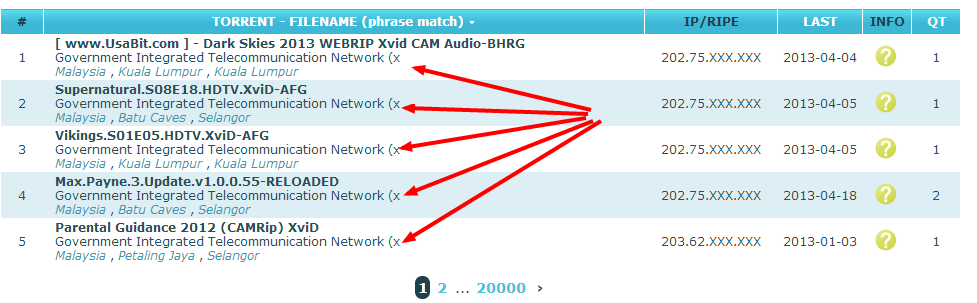
The wonderful people at Torrentfreak did an amazing piece of investigative journalism today. Upset over the passing of CISPA, they decided to do an internet check on how active the House of Representatives were–on bit torrent. It turns out with a couple of IP addresses, and some elbow grease you can pretty much find out how active a certain IP range is on bit-torrent or even on searching porn!!

So using the same techniques that Torrentfreak used, and applying them to the Malaysian e-Government official service provider “Government Integrated Telecommunication Network  (GITN)”,  your friendly neighbourhood Tech Evangelist manage to find some pretty interesting results!

The GITN is owned by Telekom Malaysia and is dubbed the “official network provider for the e-Government” in Malaysia–so let’s see what the official network for the e-government was being used for?

First off, someone was using the GITN network to download torrents–not exactly surprising, but judging by the variety of torrents (everything from Dark Skies to Naruto to Discovery Channel documentaries) it looks like more than one person was doing the downloading.

Torrent Activity on the Government Network

Also equally interesting was that someone used the GITN network to download porn. I'm no expert, but I'm thinking Gangbanged.XXX isn't really a discovery channel documentary.
[Read more]

Pitchin.my Crowdfunding success in Teach a Child to Read

A couple of months back, I wrote a short post about a Malaysian project that was successfully funded on kickstarter. Today, I can proudly say that Malaysians continue to surprise me in untold ways.

Pitchin.my is the Malaysian kickstarter, and recently it saw a successful funding of a project on it’s website–that literally brought tears to my eyes. The project entitled “Sponsor a Child to Read” was done by an English teacher from a rural school in Negeri Sembilan with a small-ish goal to raise a relatively small-ish USD3000 to provide books to 30 students with low literacy level from SMK Teriang Hilir. Let me tell you, there’s nothing small-ish about teaching 30 students.

Liew Suet Li, the English teacher who started the project, goes on to elaborate that:

[Read more]

MACC says Facebook at work is Corruption

Effects of Facebook at the Workplace

According to last weeks Star, MACC deputy chief commissioner Datuk Sutinah Sutan was reported to have said that Civil servants and staff of government-linked companies (GLCs) surfing social media or engaging in personal matters during working hours may be categorized as having committed corruption!!

The underlying logic to the argument seems plausible enough, Datuk Sutinah goes on to elaborate that:

“For instance, if a person spends three hours during his or her stipulated working hours for personal tasks, it can be deemed a form of corruption as the Government trusts and pays its employees to fully utilise the working period to complete tasks relating to the respective jobscope,”

Now while all this sounds good on paper, I think we need to delve deeper, because every time a broad statement such as this comes along it’s important to take a step back and analyze the evidence rather than rely on ‘common sense’. Common sense is after all–not so common (this reminds of the MACC lawyer who claimed the Teoh Beng Hock could strangle himself to death)

So here we have a situation where the MACC deputy chief seems to think that the social media habits of Government servants warrants a statement from such a high ranking officer and therefore logically this must be something of high consequences to the nation, much more than the RM250 Million soft-loan given to a company to sort out the nations beef issues.

[Read more]

SKMM Study: The Best and Worst Telco in KL

Who doesn't absolutely hate that feeling you get when a call gets drop, or for some reason you just can't seem to make a phone call on your network. Recently an elderly couple in America died while trying to phone for help--they had 9 drop calls in succession, which just goes to show just how important communications are in our time.

Malaysian wireless reports on an SKMM study done in the first half of 2012 to compare dropped and block call rates for the 3 major telcos in Malaysia. At the moment it’s still unclear why neither YES or uMobile have been studied but the study is a move in the right direction towards providing concrete data on call quality for Malaysians to make inform decision about the telco. Incidentally, SKMM also offer a form you can fill if you’ve experienced a dropped call–for some unknown reason the form is hosted on Google Docs, one can only think SKMM didn’t want to fork out cash to host the form  on their own servers.

First off, I’d like to point out that while I can see the report and search for direct links to the PDF version of the reports online. I can’t seem to locate any link to the report from the SKMM website, which is strange, it also appears that only Malaysian Wireless has reported on this particular study. With other blogs seemingly unaware of the study.

In essence, the study is rather simple:

According to the MCMC drive test report, the assessment was conducted with following criteria:

  • Tests were carried out in moving vehicles (Drive Test).
  • Call duration lasts for 60 seconds, with 10 seconds interval between calls.
  • Phones were set on roam-free environment between 2G and 3G networks that simulates the experience of user in making voice call using phone supporting both technologies.
  • The results of the study only reflect the behavior of the networks on the locations and time of the measurements.

Although, the methodology isn’t clear, and there are missing details, the study is a great starting point to confirm if the telco you’re currently on is providing you top notch quality. The 2 key measurements from the study were the drop call rates and blocked call rates, defined as follows:

a. Dropped Call Rate (DCR) Dropped call means a call where a connection succeed, that is, the network is accessed, call set up is successful and traffic channel has been assigned, but is disconnected due to abnormal call release. Dropped Call Rate is calculated based on the percentage of number of dropped call over total number of call attempt.

b. Blocked Call Rate (BCR)  Blocked call means a call is not connected after call attempt due to unavailability of free traffic channel. Blocked Call Rate is calculated based on the percentage of number of blocked call over total number of call attempt.

So the best telco based on these definitions is the one with the lowest DCR and BCR.  A high BCR means calls don’t get connected in the first place, and a high DCR means calls get disconnected once they’re connected. A good telco should strive for the lowest possible numbers on these 2 parameters. While the study was conducted nationally in each and every state, I thought KL would be a good place to dissect the data and provide a benchmark for the nation, if you’d like to know how your telco fared in your home state, head on over to Malaysian wireless who have all the details broken down by state.

[Read more]

IT Career in Malaysia : Why Information Technology rocks

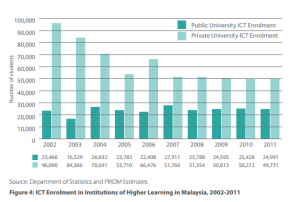
Number of IT Graduates in Malaysia by Year

So your child has just finish SPM or STPM or A-Levels and now you’re looking at a possible future career for them, or you yourself have just graduated and considering your future career. This is not something to take lightly, after all it’s the 4th most important decision in your life, behind who you get married to, when to have your first child and which EPL team to support. (hint: the answer to last one should start with M and end with anchester united)

Of course, there’s a lot of things to consider when choosing your future career and usually it’s a mixture of passion, interest and future career opportunities.You want a career you like and have interest in, but you also want a career that has future growth possibilities that match your aspirations (do you plan to live in Malaysia or move abroad…etc etc), and if you plan to stay in Malaysia you need to pursue a career that’s growing in Malaysia not something that’s growing somewhere else.

So while it’s great that you like palaeontology and want to contribute to your Tanah Air, but you’re going to be very hard pressed trying to find opportunities for digging up Dinosaur bones in Malaysia. At some point you need to keep certain things as hobbies and find a career that’s offers more progression opportunities. Or make the difficult decision of pursuing your passion somewhere other than Malaysia. It’s a difficult decision obviously, and sometimes you don’t have enough information to make these decisions–but thinking of these things now will save you a lot of heartache later on.

I think we need a lot more engineers and IT professionals in Malaysia, all this talk about transformation from the government isn’t going to happen with lawyers or politicians–it’s going to happen with technology, and unless we have more technically focused professionals entering the workforce, no transformation is going to happen (or at least no ‘good’ transformation).

Unfortunately, not many people seem to agree with me and usually when people don’t agree with me–people are wrong (the only exception to the rule is my wife).

However, I can’t understand had a decline in IT graduates over the last 10 years, and at the same time have an increase in IT opportunities in Malaysia?

A Jobstreet/Pikom report on the ICT industry in Malaysia reports that we’ve gone from 120,000 graduates per year, to just 75,000 graduates per year. That’s a bad sign on so many levels, so today as my little bit of service to the IT community in Malaysia, I’d like to tell you why a career in IT rocks.

[Read more]

Evidence Act: Anonymity before the internet

I read a brilliant article on the Evidence act by Zul Rafique and Partners that I think everyone should read. In it, the author compares the newly amended Evidence Act (supposedly amended to combat the evils of the internet) to a sub-section of the original act meant to look into telegraphs. Now I must admit, that as an internet kid, I don’t quite understand the concept of a telegraph, but the point is that even before the internet Anonymity was possible.

The public perception that is reinforced by ignorant government statements, is that with the internet has enabled anonymity which in turn has enabled crime.

According to Datuk Seri Mohamed Nazri Aziz, Minister in the Prime Minister Department, the amendments were tabled to address the issue of Internet anonymity since this very fact makes it extremely difficult, if not impossible, to trace the alleged offender.

That is a false statement.

Let me introduce you to snail-mail.

In the past, long before the internet was around, people use to communicate via letters and postcards that were hand-delivered by postmen to your doorstep. This is a foreign concept to most children but it’s good to let them know just how hyper-connected they are in relation to their parents or grandparents.

When you send a letter, you write a note on a piece of paper, sign it at the bottom (presumably with your name) and then place it into an envelope. You then write the name and address of the recipient on the envelope, afix a stamp (that acts as a proof of purchase)–and then drop it off at any post office you see fit. The Post Office then somehow routes that letter to the recipient on the envelope–physically hand delivered.

Notice–you never have to prove your identity when you send a letter or postcard. No where in the chain of events are you ever asked for your IC or phone number, in fact I could just as easily write a malicious letter, post it to the Prime Minister and sign it as Datuk Seri Mohamed Nazri Aziz. Would the Prime Minister then automatically assume his cousin sent him the letter just because it was signed in his name?

I guarantee you it’ll be harder for the authorities to trace that physical letter as opposed to a similar digital email. Too many people watch CSI these days to believe that statement, but there’s a reason why kidnappers still use physical constructs–because in the digital world you always leave a trace.

If we apply the amended Evidence Act to the letter analogy, Datuk Seri Mohamed Nazri would be charge for sending that malicious letter to the Prime Minister–even though he never wrote it. All of us understand the stupidity of assuming someone sent you a letter just because the letter was signed by that person, yet we seem to think nothing of it in terms of emails. In fact, if I wanted to get Nazri into a whole heap of trouble, all I’d have to do is send 1000 similar letters to 1000 different people, and sign it with his name–in that way, he’d be charged 1000 different times in a 1000 different court proceedings and even though he might be deemed innocent on each count, it’s still a whole load of trouble I can cause for him for the price of 1000 stamps (roughly Rm500 which wouldn’t pay for even one hour of a lawyers time).

[Read more]