Posts for: #CyberLaw

Malaysiakini goes free from 17th April for GE13

Got a note from Malaysiakini today, for all you stingy-porkers out there who read all the malaysiakini news reposted by various parties, but never really paid for the subscription–here’s some good news.

Malaysiakini will go free from 17th April onwards, to pave the way for MORE adverts (like we didn’t have enough) but also to allow Malaysiakini to respond to attacks more effectively. Having to cater to two customer models makes responding to DDOS attacks a bit harder–though I can’t imagine why.

It’s however good news all-around. Malaysiakini will extend the subscription if you were already paying, and if you never were a customer, you now have access to all the news from Malaysia no.1 Online News Portal.

[Read more]

My BN Spam SMS collection


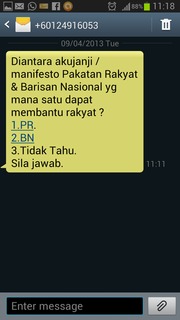
In the past 6 months, I've received more than 20 political SPAM sms' from the Barisan Nasional Yakini BN campaign, various political surveys and two from my local MP from PAS (Dr. Siti Mariah Mahmud).

Now obviously, I’m expecting the spam rate to increase exponentially as we approach GE13, and to me that’s really bad news. In fact over the last month alone, I’ve received 5 text messages from the Barisan Nasional Yakini BN campaign–they know my FULL name, my contact number and even my place to vote. They know more about me than I’ve ever given out to ANYONE from any survey, and I consider this an invasion of my privacy.

[Read more]

Malaysian Cyberwar: Is it an external war or is it civil

The Cyber War between Malaysia and Philippines

A really piece written by Asohan Aryaduray on DigitalNewsAsia some time back talked about how the CyberWar between Malaysia and the Philippines was going on, and how he wanted government agencies to step up the security of our digital assets (or at least start the discussion). Asohan claims that Malaysia perhaps has “the most number of government and quasi-government agencies looking into cyber-security for a country this size; it is time for them to put their heads together and harden the nation’s cyber-defenses.” 

He ends with a rather poignant phrase: It’s war, gentlemen, and it’s time our agencies got cracking.

I’m not so sure it’s war–even less sure we should get the government involved.

If he calls the attacks by Malaysians on Pinoy websites (and vice-versa) a war, then what’s currently going on with the DAP website is a sign of not just war–but a digital civil war, with internal actors, attacking local sites.

TheStar last week reported that the:

DAP has claimed that its websites have been attacked and forced to shut down since last Friday.

National publicity secretary Tony Pua (pix)said the party’s official website, dapmalaysia.org, and its Malay portal, roketkini.com, were incapacitated by denial of service attacks (DDOS) on March 8, 10 and 13.

While TheStar doesn’t report it, but other newsportals claim Pua was blaming political foes for the attack. For the most part this is quite common, we’ve seen Malaysiakini go down a few times, and various other pro-opposition blogs have taken some hits. This of course is even more interesting because Krebsonsecurity.com blogged that he was a victim of not just a DDOS attack but Swatting as well.

[Read more]

Malaysian government using spyware against citizens? No, not really.

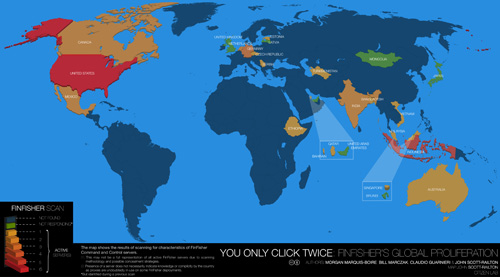
FinSpy server found in Malaysia

I’ve been pretty busy the past few months, and my post count has been pretty low, and although I just returned from a 2 week trip abroad and am now flushed full of work, I decided to burn a bit of the midnight oil today because the Malaysian Insider completely pissed me off.

It all started with an article from Lim Kit Siangs blog, which read “Malaysia uses spyware against citizens, NYT reports”. The post was merely a cut-and-copy reproduction of a Malaysian Insider article that had the same headline. The headline really got my blood churning and it was followed up with an even more mouth watering opening paragraph:

[Read more]

Is the MCMC going to ‘monitor and control’ or is it going to ‘censor’

A week ago, I wrote about the MCMC was planning to ‘monitor and control’ the internet, but just today I looked at my RSS subscription and notice that the Malay version of the press release used completely different words.

While the English version of the Press release used words like ‘monitor and control’, the Bahasa version used the term ‘memantau dan menyekat’. The term ‘memantau dan menyekat’ more appropriately translates to ‘Monitor and Block’ or ‘Monitor and Censor’ rather than ‘Monitor and Control’.

[Read more]

MCMC looking to ‘control’ social media at GE13: A worrying trend

Bernama (an official government news channel) yesterday reported that the MCMC is “looking at suitable methods to monitor and control the use of social media in the 13th General Election (GE13)". Deputy Information Communications and Culture Minister Datuk Maglin Dennis D’Cruz said this was “to ensure that the social media would not be abused by irresponsible quarters to achieve their own political agenda”. Datuk Maglin then quickly goes on to shameless promote the BN by saying that “Therefore, the public, especially the young voters should be wise enough to do their parts in selecting the right government with vast experience in managing the country, so that their future will be secured.”

[Read more]

Are your broadband meters accurate?

Broadband meter caps

When Maxis, or Telekom or Digi claim that you’ve used all your bandwidth quota–can you really trust them? A good article from consumerist reported that even American telcos are facing difficulty counting the bytes their users use.

For the most part this is OK if your ISP provides you unlimited quota, in which case it doesn’t matter how much you use. However, if your ISP is either charging you per byte (like Yes 4G prepaid) or capping your speeds once you exceed a certain threshold, then they’d better be sure that they’re accurately counting the number of bytes you’re using before they starting capping speeds. So if you’ve got a bandwidth quota or a data cap, it’s in your interest to ensure your ISP is measuring your usage accurately, otherwise you could potentially be billed for data you never used.

It’s also interesting to note, that in some cases what the ISP measures as your data usage, is not what you will measure at home. A GigaOm article detailed out Chicago Area Resident, Ken Stox tried to simulate his ISPs metering his own meter at home. Stox installed a Linux application called Tomato, which basically is a Linux program installed on his router that allowed him to write programs to track his usage.

Knox reported on Slashdot that:

[Read more]

Are Free Public WiFi initiatives safe? Or do they pose a Health Risk?

Techdirt recently reported on how Canadian Schools are Banning WiFi based on bad science, and I was appalled by the complete lack of science we have operating in the minds of these clueless parents. No doubt they’re well-intentioned but their complete and utter disregard of the scientific evidence in favour of fearful knee-jerk reactions are actually causing more harm than good for the very children they intend to protect.

Of course it doesn’t take much research to find out that WiFi isn’t dangerous, and there’s no evidence to show that it is dangerous. In fact, most studies suggest WiFi radiation is so weak, that a year of WiFi radiation equals to 20 minutes on a cell phone. The most important thing of course is not to fall into the trap of thinking we’re ‘better safe than sorry’ because we already are safe with WiFi and we have enough evidence to suggest what WiFi poses to health risk.

Wireless@PENANG : The Health risk of Public WiFi

I'm also reminded of Wireless@PENANG project, that took so long to launch due to pressures from public groups and NGOs similar to the Canadians parents. This includes flak from Anil Netto (a journalist I respect) , who wrote a couple of post about how the public were not consulted about the Wireless@PENANG and how the European Parliament has begun to be wary of Wifi.  All of this of course didn't bode well for the Penang Government, because they had to organize a town hall on the matter, fortunately the science prevailed and Jeff Ooi (whom Lim Guan Eng branded as 'tech-savvy') announced that the project was back on track shortly after the town hall.

Unfortunately, the consumer association of Penang wrote a long open-letter to Lim Guan Eng, chastising him for not engaging them enough. It was clear from the letter than the Consumer Association, while having the right intentions in mind–were clearly misled in terms of the science. It was even clearer that all they wanted was for them to be engaged, but from my end I can’t see how a consumer association who has looked at the scientific data (and lack thereof) not conclude that the benefits of WiFi almost astronomically dwarf the ‘perceived’ health risk– quite frankly there are no health risk. More to the point, I would not even begin a conversation with them, till they point to some scientific proof of how WiFi is a health risk. At present there is no such data.


[Read more]