Posts for: #CyberLaw

How corporations lie to the technologically challenged

wpid-wp-1442992521638 (1)

Two weeks ago, Lowyat.net published a ‘challenge’ to their readers, one that would supposedly pay a cool RM100,000 to the winner.All you had to do was decrypt an AES-256 encoded blob of code (more accurately referred to as ciphertext).

As expected, no one won.

Because breaking that ‘military-grade’ encryption is beyond the capability of most normal human beings, and certainly not worth a paltry RM100,000 that was being offered. It’s the equivalent of offering 50 cents for someone to build a rocket capable of going to the moon. In fact, Rm100,000 is exactly the cash prize celcom offered for it’s cupcake challenge, because baking cup-cakes and breaking ‘military-grade’ encryption are the same thing.

Once the challenge has expired, Celcom conveniently launched their new zipit chat application, which surprisingly used AES-256 encryption as well, and more importantly they released some statistics of a ‘hackerthon’ they conducted in which 18 Million people viewed the challenge, and 17,000 registered to participate but none succeeded.

OK, so while there was no official announcement from Celcom to tie the original lowyat challenge to their new zipit app, it was quite plain for all to see.

So let’s go into why this upsets me.

[Read more]

Why we fear ‘hackers’: Dangers of Technical Illiteracy

anonymousmask380-300x225

Are you afraid of Hackers? Do you lie restless at night thinking of what might happen if they got into your bank account, facebook profile, or e-mail. Perhaps you’re also worried about that they might hack into a forum you visit, or that they might get into your personal messages on whatsapp.

It’s true that hackers are able to do all of these things, but the public perception of hackers really isn’t quite justified, and this false perception can lead to terrible outcomes.

Take last weeks post about the hacktivist group Anonymous. In it I expanded on the public fear of anonymous and how that didn’t correspond to the actual damage that the group causes. Sometimes all Anonymous does is a DDOS on a public website, that still takes some skill, but far removed from actually infiltrating a server. Yet, most people wouldn’t be able to differentiate a DDOS attack of a website to a compromise of an actual server, and this inability leads then to disproportionately fear hackers, worse still it leads them to lump all security related incidences into a single bucket called “hacked by hackers”.

But Why?

Why are people so afraid of hackers? And why is there a huge discrepancy between what some of these hackers are actually doing and the fear that the average citizen has of them.

I have one theory–ignorance, or more specially tech-illiteracy.

[Read more]

Our Communication Minister must be mistaken

Our newly appointed Communication Minister has come out all guns blazing in directing the The Malaysian Communications and Multimedia Commission (MCMC) to ask social media giants such as Facebook, Google and Twitter soon to block “false information and rumours” on their platforms.

That in itself is quite frustrating, but what really got me scratching my head was his claim that “that social media providers acted on 78 per cent of MCMC’s request for removal of content last year, with Facebook taking action on around 81 per cent of its request.”

[Read more]

Should an IP address be used to Identify someone?

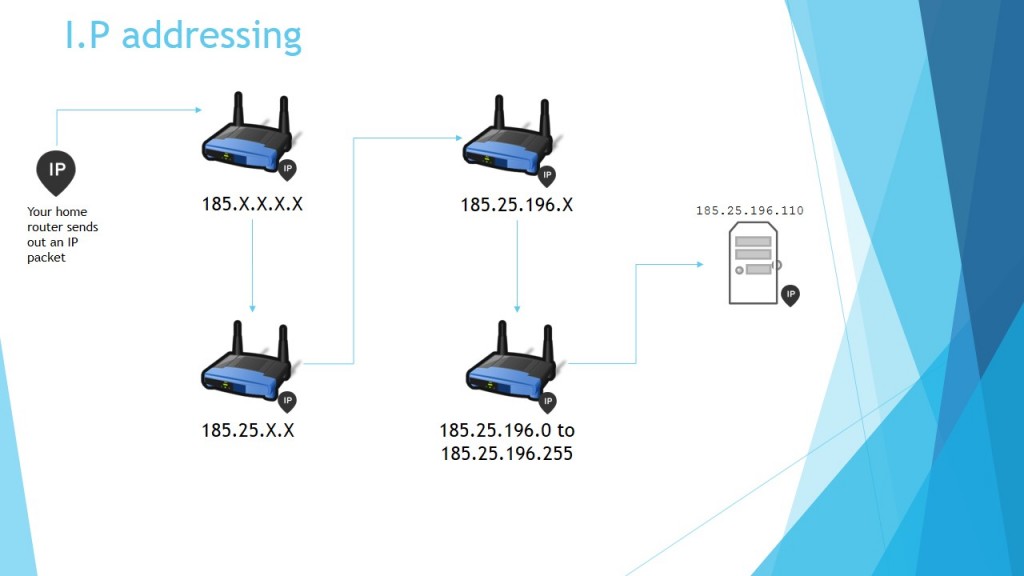
How IP addressing works

Recently a court in Malaysia ruled that the newly amended evidence act could presume an IP address would uniquely identify a user of a network, and in the case of an Internet IP address, enough to tie an IP to the individual subscriber. In other words if the authorities ever found out that ‘your’ IP address was behind a post, then you’d have to prove it wasn’t you rather than they having to prove it was.

In Tong Seak Kan & Anor v Loke Ah Kin & Anor [2014] 6 CLJ 904, the Plaintiffs initiated an action for cyberspace defamation against the 1st Defendant.   In tracing the perpetrator, who had posted defamatory statements on two Google Blogspot websites, the Plaintiffs filed an action called a John Doe action in the Superior Court of California.   In compliance with the court order, Google traced the blogs to two IP (Internet Protocol) addresses which were revealed by Telekom Malaysia Bhd to be IP addresses belonging to the 1st Defendant’s account.

Bread & Kaya: Malaysian cyberlaw cases in 2014

Upon further reading of the post on DigitalNewsAsia, my non-lawyer mind got the feeling it didn't end well for Loke Ah Kin & Anor as the court decided they were guily of defamation based on a flimsy piece of evidence like the IP address of the user who posted blogspot.

I’m uncomfortable that a court of law could find someone guilty based on something as trivial as an IP address, when other courts around the world have ruled that IP addresses are insufficient for this purpose.

[Read more]

Jho Low uses Gmail? Why emails can’t be considered evidence

15197804185_d4a1f3d9b3_m

As the 1MDB fiasco begins to simmer over the political stove, I wanted to inject some technical information into this discussion, specifically around emails and how they’re almost useless pieces of evidence.

Just to make sure everyone’s on the same page, here’s some context.

In early March 2015, sarawakreport.org, a website run by investigative journalist Clare Rewcastle-Brown together with the London Sunday Times, published an article on controversial deal done by the 1MDB fund. At the centre of the deal was a man named Jho Low, who masterminded a sophisticated ‘wheeler-dealer’ that pocketed him $700 Million, all of which (at least according to sarawakreport.org) was siphoned from 1MDB, a Malaysian sovereign wealth fund.

Honestly, I don’t understand the financially complex deals that sarawakreport.org was trying to explain to lil ol’ me. So I’m just going to take her word here, that all the documentation that was produced leads to the conclusion that Jho Low masterminded the “Heist of the Century” by stealing $700 million through shady back door deals involving 1MDB and a company called PetroSaudi. But then of course, the question becomes, can you trust the documentation.

Reading the article you get the sense that the e-mail trail presented forms the backbone of the entire story, and if the emails themselves are not true then the entire story is untrue as well.

In either case though, let’s get straight to the point, and say that e-mails by themselves are quite useless.

[Read more]

MyProcurement: All government tenders in one Excel file

MyProcurement

I've updated this post on 31-Mar-2015, to incorporate the latest changes, and to provide more up to data info on the procurement database. Left everything else in tact.
Happy birthday Malaysia!! Just how awesome is our country, that we celebrate an Independence Day AND a Malaysia Day, not to mention 2 New years day, (or 3 if you count Awal Muharram).

So on that note, I decided to use my IT skills for the good of the country.

To be honest, my IT skills have never been up to par, my day job is more managing/planning/documenting than actual execution of ‘real’ IT work. But it was good for me to dust of the ol’ programming fingers and learn Python to grab some publicly available information and make it more accessible to the less IT centric members of society.

Since I had limited time, and sub-par skills, I decided to set my sights low, and aim to extract all the data from the Malaysian MyProcurement portal, which houses all the results of government tenders (and even direct negotiations) in one single website for easy access. The issue I had with the portal though, was that it only displayed 10 records at a time–from it’s 10,000+ record archive, so there was no way to develop insights into the data from the portal directly, you had to extract it out, but the portal provider did not provide a raw data dump to do this.

So I wrote a simple Python script to extract all the data, and prettified the data in Excel offline. The result is a rather mixed one.

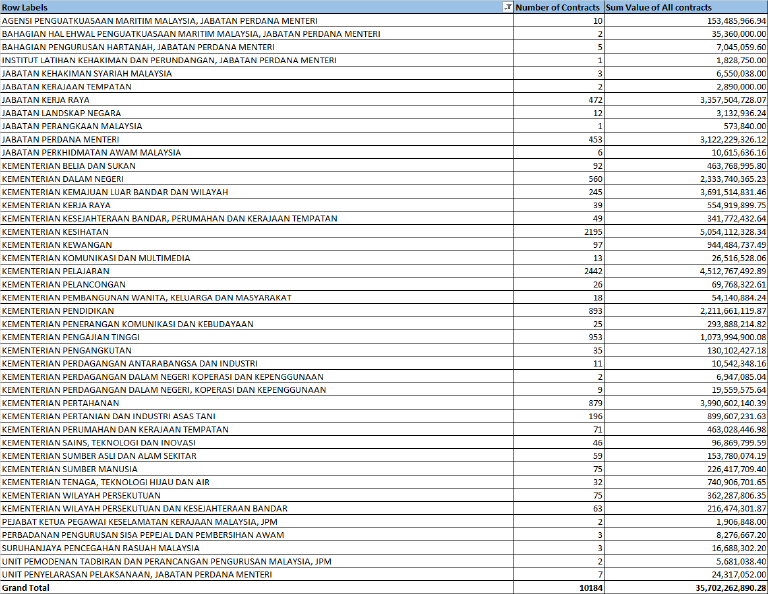
I was happy that I could at least see which Ministeries or Government departments gave out the most contracts, and what the values of those contracts were. All in all, the excel spreadsheet has more than 10,000 tenders with a cumulative value of RM35 billion worth of contracts going back to 2009. The data allowed me to figure out which Ministry gave out the most contracts, the contracts with the highest and lowest value (including one for Rm0.00, and one for just Rm96.00). All in all it was quite informative.

Results_by_ministry

[Read more]

Is Malaysia’s Broadband slow–no it isn’t.

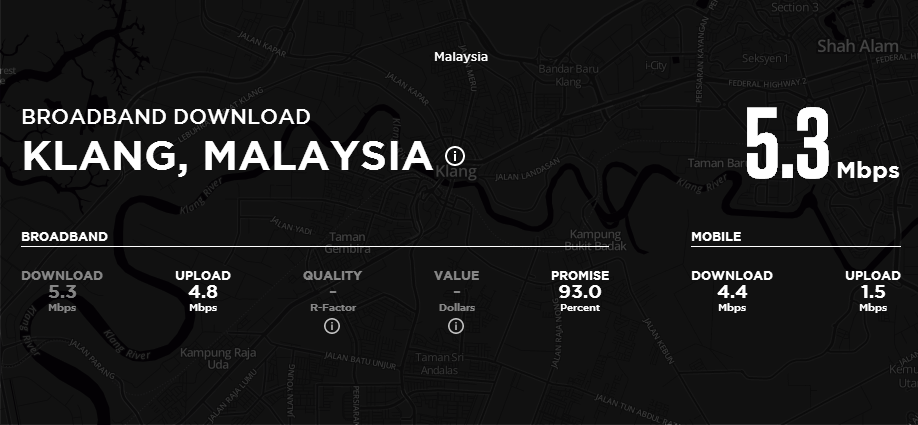
Broadband_speed_klang_malaysia

Recently KiniBiz did a piece on Malaysian broadband speeds, and once again the hoopla about how Malaysian broadband speeds are slow arose. Kinibiz quoted an article from Asean DNA which stated that the average broadband speed in Malaysia was just 5.5 Mbps, while Thailand, Vietnam and Singapore had speeds that were double that (or more!)

The report however was inaccurate, and I think there’s a need to address the hoopla, because this happens often. There was a report couple months back that said Cambodia had faster speeds than Malaysia, and I wrote a post addressing that. This time I think, we have to really go into the data and find out what exactly is going on.

So let’s start at the source of this data.

The data was built from billions of download test conducted by users throughout the world on speedtest.net (a website that allows users to test the speed of their internet connection). This dataset is HUGE!, one of the biggest I’ve seen and definitely the biggest I’ve had the pleasure to play around with. Just one file in the set had more than 33 Million rows and weighed in at more than 3.5GB.It took me some time and lots of googling just to figure out how to deal with a csv file this large. Fortunately, there’s LogParser, but we’ll skip that tutorial for now and focus on the juicy details of data.

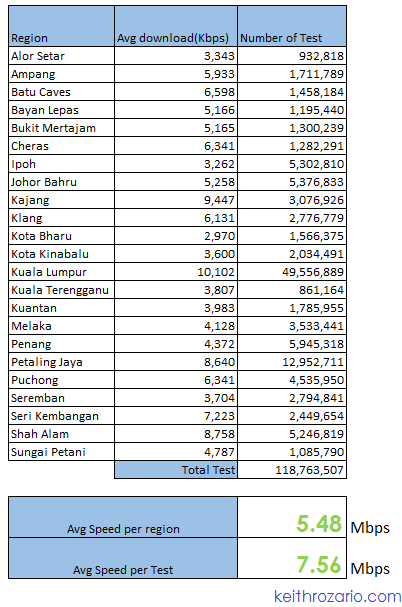
The number reported by Asean DNA is wrong. The average internet speed in Malaysia isn’t 5.5Mbps, it’s more like 7.5Mbps.

5.5 Mbps was obtained by averaging the speed across the regions of Malaysia (Kl, Alor Setar, Klang..etc) rather than by averaging the speed across all the test conducted by Malaysian users. In short, Asean DNA placed equal emphasis on Kuala Terengganu and Kuala Lumpur, although Kuala Lumpur had 50 times more test conducted. It would be like calculating GDP per state, rather than GDP per capita. The real per capita download speed in Malaysia is 7.5Mbps, rather than 5.5Mbps (if you limit yourself to just data from 2014).

Here’s the breakdown. You can download the file from netindex.com or just use an extract I created with just the Malaysian data–it took some time to do this so leave a Thank you in the comments if you downloaded the data.

Average-speed-internet-Malaysia

[Read more]

A Techie’s view on the Law

2283584007_f199332890_z

Are some laws worth following–in other words, are some Laws so idiotic that they should be ignored completely?

That sounds anathema, because we have a romanticized definition of the law, we define the Law as a broad general agreement a society undertakes, and the law keeps society from tearing itself apart. In other words, the law is so sacred because without it–we descend into anarchy, so ignoring the law is akin to promoting anarchy.

But I’m not speaking of “The Law”, I’m speaking of “A law”, specifically an Act of Parliament. “The Law” refers to a vast conglomeration of many things, including constitutions (state and Federal), statutes, precedence of case law and Acts of Parliament. I’m not sure what a statute is–but I roughly know what an Act of Parliament is, and it surely isn’t a broad general agreement that society depends on to stave off Anarchy–rather an act of Parliament is a law brought into effect by Parliament–nothing more nothing less.

To my techie mind, that means that 222 Members of the Malaysian Parliament got together to enact a piece of legislation. Romantically we think this is the people’s will–the Rakyat voted these people into power and they now wield this power to enact laws that will protect the Rakyat. A glorious cycle of virtuosity that only democracy can deliver. That’s wishful thinking, realistically it’s a law brought into effect by 222 voting members of Parliament whose collective IQ would probably not exceed that of the Zoo.

So when these 222 MPs ge t together and enact legislation to regulate technology–I get a bit uncomfortable. Not only do most of them not have engineering qualifications, half of them don’t even have a website. Having these MPs enact legislation that will regulate a field they’re clueless about, is akin to getting open heart surgery from a car mechanic.

On a side note, a techie like me has a hard time understanding why we have 222 seats in Parliament. It would seem, that in a first past the poll system, you’d want to have ODD number of seats, to avoid the situation where 111 members belong to Barisan, and the other 111 belong to Pakatan (what happens then?). That’s just ONE of the many things an engineer would quickly realize is wrong with the entire system–and that’s why we only have 3 engineers in Parliament (at least according to the Sinar Project).

[Read more]

CheDet on Censorship

Tun Dr. M

Tun Dr. Mahathir now says he’s change his mind about internet censorship. To quote him “Not knowing the power of the Internet, I promised that we (speaking as the Prime Minister of Malaysia) would not censor it. But today I have changed my mind."

Of course, everyone has a right to change their mind–but in this case Tun went from being absolutely spot-on (the internet doesn’t need censorship) to dead wrong.

[Read more]

Internet Censorship is an invasion of privacy

internet censorship

With the on-going debacle about the Kangkung saga dying down, I thought it would be a good opportunity to write specifically about internet censorship and its implications to ordinary Malaysian citizens. As you may well know, many Malaysia Netizens reported of difficulty accessing one particular post of the BBC website that dealt with the Kangkung issues, causing many to cite that Telekom Malaysia was actually censoring the internet--but what does internet censorship actually entail for Malaysia?

Let’s first take a step back, and understand how and Internet Service Provider (ISP) like Telekom Malaysia, Maxis or Digi operate.

[Read more]