Posts for: #Crowdsourcing

OpenSource Gold: The greatest Crowdsourcing story ever told

Crowdsourcing is a funny term, and people often ask me what does crowdsourcing have to do with technology, to which I reply–EVERYTHING!

Without the vast internet and communications made possible by it, crowdsourcing would be a fools dream. Right now, I work in an environment so virtual that the first time I met my project manager face to face was last week at a conference, a full 6 months after the project started. It’s a really exciting time, because it allows people to work in a boundary-less world.

The internet and technology enable crowdsourcing, without the internet, there is no crowdsourcing. It gets more interesting because as more and more big world problems emerge, crowdsourcing may become an acceptable way to solve them–all enabled via technology and the internet although crowdsourcing in itself is not technological.

This great video from Don Tapscott (author of wikinomics), really provoked in me some thinking on how we approach data and information.

In about the 4th minute you'll notice Don tell a story of his neighbour, the CEO of Goldcorp and how the crowdsourced the method of Gold Mining. The story is amazing, and be found in detail here and here.

It’s amazing, and here’s how it goes.

The story of the Goldcorp challenge

[Read more]

Instagram Camera: Coolest thing EVER!!

A couple of weeks back, I wrote about a cool card game based on Computer processes, in hindsight the only thing that post proved was that I’m a geek. The card game was funded through a crowdfunded initiative, and that was really what made it cool.

The instagram camera is cool on its own, and the fact that it’s currently  being crowdsourced through Indiegogo (a website similar to Kickstarter) makes the cool factor– cucumber cool.

In fact, as of now, it’s already reached $6,000 dollars from it’s $50,000 target in just one day. I’m willing to bet that this project will eventually reach it’s pretty low target of just $50,000 – easily.

There are however, some copyright concerns surrounding the camera, particularly since Facebook now own Instagram and they don’t even like wordpress developers building themes that ’look’ like facebook, much less an entire camera that is based on a trademark they own.

If you choose to fund the project, you’re promised a discount on the final item, which the creator hopes to price at under $350 (that’s in US Dollars). However, based on the specs, that may be a bit difficult, we’re talking about a:

[Read more]

Confirmed: Crowdsourced reviews are better than Professional critics

A study by the Harvard Business School published in april 2012 via it’s online portal HBS Working Knowledge, confirms that “Expert ratings are correlated with Amazon ratings, suggesting that experts and consumers tend to agree in aggregate about the quality of a book. However, there are systematic differences between these sets of reviews.” In layman terms that just means that expert ratings are just as good as the average joe commenting on Amazon. It’s something I’ve suspected all along, that crowdsourced reviews from Amazon, tripadvisor, goodreads and IMDB is just as good as the ‘professional’ reviewer you see in magazines and paid adverts.

The study, which can be downloaded in it’s entirety here, is a really great read, that’s not too technical, but it’s not overly simplistic either so be prepared with some of your high school statistics for this one.

[Read more]

Crowdsourcing Taxi Reviews

One of the stark differences between Malaysia and Singapore (besides the remarkably better food in Malaysia) are the Taxi Drivers. I used to frequently go to Singapore for business trips and for just about everywhere I went, I chose the taxi, either a friend would help book a comfort cab via their iPhone app, or I’d just call the hotline to book one. I’ve never once been turned down by a Taxi Driver, and I’ve never once had a driver negotiate the price with me. There it was all meters, it was all on the up and up.

In Malaysia however, the situation couldn’t be anymore different, and so its good to see someone (other than the government or Taxi company) trying to help solve the problem by using a smartphone application to crowdsource taxi reviews. On the face of it, the idea is brilliant, have people write reviews of taxis and then collate that data online. It makes it so that ‘bad’ taxi drivers get penalized and ‘good’ taxi drivers are rewarded.

[Read more]

The UK crowdsourced Auditing for MPs : Malaysia Boleh?

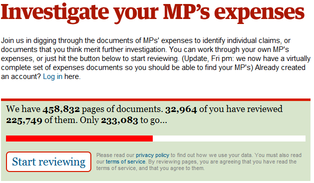
One thing is true of all governments, the most reliable records are Tax records. That is one of the coolest quotes from a very cool movie (which is saying a lot). In V for Vendetta, the heroes try to piece together a puzzle by visiting the tax records to locate some missing information, in real-life we’re also faced with the same problem. No matter how corrupt or bureaucratic you think the government is, there will always be a paper-trail for money and sooner or later someone will find it. The solution for a crony-heavy government was simple, load the system with bureaucracy so no one will find out. The problem was while no ‘one’ may have found out, a group of inspired citizens armed with nothing more than a proper system can troll down all the bureaucratic walls you can build.

A couple of years ago, the Guardian newspaper set out to go through all the tax and expense claims of every single member of parliament. While the fallout from the reports were clear, less publicity was given to the actual method that the newspaper used. People naturally assumed that when the news read “Guardian reports MP claims….” , that a regular journalist working for the paper trolled through some documentation and arrived at the results. Usually the assumption includes a snarly eyed journalist with big black thick-framed glasses, gulping down gallons of coffee while his tie came loose, just an assumption of course.

[Read more]

Igor Presnyakov succeeds in getting kickstart-ed

Now some say he lives in Amsterdam and lives only on cheese,that may be fiction but damnit this guy is the best guitarist I’ve seen. Check out Igor’s rendition of Canon from the youtube embed above and you’ll know what I’m talking about, or just head on over to youtube and check out the countless songs he’s played on youtube including sweet child of mine or someone like you. It’s absolutely amazing guitar playing, and it’s all posted on youtube by Igor himself, for you to enjoy…for Free!!

[Read more]

Using the crowd to predict the future

I just finished Crowdsourcing by Jeff Howe, the definitive book on crowdsourcing, and although it was written nearly 4 years ago, I was really bowled over by key insights throughout the book. Crowdsourcing is more than just the design work or iStockphoto, there’s also an offshoot into the world of Crowd-predicting. Utilizing the wisdom of the crowds to predict anything from sports results, Hollywood sales or even Presidential elections, and it appears these prediction markets actually do a pretty good job of predicting the correct outcome. They’re not right 100% of the time (then again neither are the experts), but overall the Crowds can –and do–predict with great accuracy.

The premise of crowd-predicting is simple. Get a whole bunch of people together and then ask them to predict the outcome of a particular event, once each individual prediction comes through you then aggregate that information to get the final result. Proponents of crowd-predicting say this result often beats the ’experts’, and they have some data to back it up.

[Read more]

Can we use crowdsourcing for Autistic people?

Yesterday, a doctor by the name of Sandra posted a comment on my blog about how she thought crowdsourcing could help disabled people particularly those with bipolar disorders get jobs online. If anyone in the crowd can contribute to a crowdsourcing initiative then even those with bipolar disorders should be able to do it, and they should be paid the same amount. It got me thinking about an article I read in the New York Times some months back on a non-profit startup called AspireTech was actually getting work for autistic adults not ‘despite’ them being autistic but because they were autistic. Autistic people are generally able to perform the same repetitive task over and over again without losing focus or getting lethargic, and they’re way more adapt at this than the rest of the general population.

This fundamental advantage they have makes them perfect for roles as software testers and even programmers. I always dread testing anything, especially when it’s doing the same thing over and over again, let try uploading a 5MB file, now a 10MB file, now a 100MB file…on and on and on. These test provide critical data for any software project but can be very very cumbersome to accomplish since they require repetitive work to be done over and over again with minimal variance. At least it’s hard for me to do, particularly since my wife says I’m not too good with instructions.Individual with autism are extremely adapt at this and they’ve proven their worth. In these areas autism is an asset not a liability.

[Read more]

How much do you trust Google?

I basically live on Google servers, the first sites I visit when I wake up are Google Mail and Google Reader, without these two sites I’m basically lost. I seldom log on to facebook anymore and twitter may keep me occupied for about an hour, but after that I need my fix of Google. Google is such an integral part of our lives, in fact since 70% of my readers come here via a Google search, chances are you wouldn’t be here reading this very post right now–without Google.

The question then becomes how much do we trust Google? Have we really thought about trusting Google given how much we rely on it. Think about it if Google were to go down, where would you go for more information. Chances are you’d head on over to bing, take bing away and you start having problems.

How do you search for search engines, when you don’t know any??

[Read more]

Why ReCaptcha works: The 4 requirements of Crowdsourcing

If the 5 of you can’t decide where to eat lunch without saying the dreaded words “up to you”, how in world can 100,000 or even 1 million people combine together to solve a problem? The answer is through a mixture of the right collaborative systems enabled by the right technology and people with the right skill-sets motivated by the right things. Get all 4 components right, and you’ve got yourself the answer to any problem.

However, getting these 4 components right is very very tricky.Some might argue it’s more difficult than solving the task at hand, but a handful of successful crowdsourcing projects have broken the mold and set the tone for others to follow. Today I want to focus on what is quite possibly the biggest crowdsourcing project ever, and with the exception of wikipedia is probably the most successful as well. ReCaptcha.